JUKE JOINTS: A TIME TO WEEP . . . AND A TIME TO MOURN . . . DECEMBER 7, 1963

From the MCRFB NEWS archive: 1963

Juke Box Play Ceases As Nation Mourns


NEW YORK — Play on the nation’s 450,000 juke boxes was back to normal Friday, November 29, but for a 72-hour period last week few Americans had the stomach to listen to the mechanical music makers.

Juke Box B&W PicAutomatic phonograph and game collections last weekend and Monday, November 25 were scanty, as millions of Americans stayed by their radios and television sets to watch the news developments and to view the funeral of President John Fitzgerald Kennedy.

Even when surface normality was restored Tuesday, November 26, the gaiety commonly associated with taverns and restaurants were muted. And when patrons put their coins in the juke box, they did so in an almost mechanical manner.

Manhattan itself was almost a ghost town through the weekend and on Monday, November 25. Normally, Friday and Saturday nights are the big money makers for Gotham tavern owners. And these are the evenings that get that the heavy jukebox and game play. But few patrons were in the mood to play the juke box or coin-operated games. Most of them stayed home and watched the ceremonies on TV.

In Chicago, the coin machine business ground to a halt immediately following the tragic and bizarre series of events connected with the assassination of the President.

Juke boxes and games were shut off as the city’s attention turned elsewhere — first to the tragic scenes in Dallas, then to the mournful culmination of those scenes coming out of Washington, Monday, November 25.

Chicago Clubs Closed

Throughout the Windy City night clubs were closed, neon signs were dimmed and while some taverns were operating — at half capacity or less — talks inside were loosely centered on the Dallas tragedy and news instead, by its patrons, while glued to the establishment’s TV sets. Bands and combos were silent. Friday was the worst evening as people just couldn’t seem to comprehend what had happened.

By Tuesday did locations start to return to normal and even then the return was gradual and deliberate. Juke boxes which have been turned to the wall, were again plugged in, but there was no rush to play the coin-op record machines.

A check with the trade showed that over-all collections were off s much as 50 per cent or more. The comments of Earl Kies, head of Apex Music Company, are typical.

“We know for sure collections will be affected — we can judge by the service calls, they’ve been nil.” Kies said his service men were out on the streets but none had more than two calls a day.

“Many of the locations had out-of-order signs on the juke boxes,” said Kies. The Chicago juke box operator estimated that close to 80 per cent of his machines were down for the weekend and that his week’s collection would be off from 30 to 35 per cent.

Cleveland Juke Boxes Silent

In Cleveland, a crack of 21 guns echoed against the concrete and brick walls of the empty heart of this city this past Monday, November 25, the national day of mourning.

The city wept.

Virtually all businesses and industry closed down. Neon lights closed their eyes. Nightclubs and cafes, restaurants and movie houses closed their doors. A few remained open but there were few found inside.

A number of bars remained open but coin operated games and juke boxes remained silent. One bar which served a few patrons honored President Kennedy’s memory by displaying signs which over the darkened jukebox: “Will remain silent (today) in honor of our departed President — The Management.”

Most operators in this area reported the same experience. The few drink spots that remained open pulled the plugs from the music machines. Radio and television sets kept their patrons informed at every detail of the assassination and the burial of the former President.

The area operators generally figured the take for the day to be but a fraction of the normal volume. “But who can be concerned about it at a time like this,” said one prominent music man.

Joseph Abraham, president of Lake City Amusement, one of the oldest operators in terms of years in the business, reflected everyone’s attitude concerning the death of President Kennedy. “We’re all very shocked . . . we will be for a long time. It seems impossible that would happen in our country. Everything closed down. The bars, restaurants, a lot of plants and offices.

“Sure we lost some income . . . . but who cares at a time like this? All the boys feel the same way. Who could think of dollars and cents at this hour?”

In the streets, New Yorkers pick up the latest news on a car radio
In Manhattan on Friday afternoon, November 22, New Yorkers pick up the latest news out of Dallas on a car radio. (Click image for larger view)

Charles Comella of Cadillac Music Company added: “We’ve actually been out of business since Friday, the day President Kennedy was assassinated. And believe me we’d stay out of business for two more Fridays if we thought it would bring him back!

“One of our locations that stayed open the day of the burial reported that the men sitting at the bar broke down and cried. We all were crying inside. It helped us put our lives in proper perspective.”

Milwaukee Pulls Stop On Music

In the state of Wisconsin, the same effects were reported from Milwaukee. Juke boxes stopped spinning Friday afternoon when the stunning news of the assassination of President Kennedy flashed over radio and TV sets. For the rest of the weekend the city’s taverns remained somber and silent.

“There has never been anything to compare to this type of reaction. Everything halted completely when the news hit. The music stopped and hasn’t started up yet,” reported Harold Opitz, Wisconsin Novelty Company, on Tuesday morning, November 26. “There has been no gaiety around here for four full days. Some of our better stops here say they never experienced anything like it. A lot of our locations cater strictly to Negro clientele. We they are quiet, you can bet tavern business is quiet all over. Many of the pubs completely closed down until after the President’s burial.”

According to Sam Hastings, Hastings Distributing Company, president of the Milwaukee Phonograph Operators’ Association: “We haven’t had time to completely evaluate the drop off. But, we know our take fell at least 25-50 per cent below normal.

“Our best barometer is the number of service calls we receive over a given period. Saturday, we had one service call. Normally we expect several dozen service calls during the weekend. From what other operators tell me, they all experienced the same decline in business as we did. It was noticeable all over the metro Milwaukee area. Tavern business was hit hard, and so was the coin machine industry.” END

___

(Information and news source: Billboard; December 7, 1963)


Loading

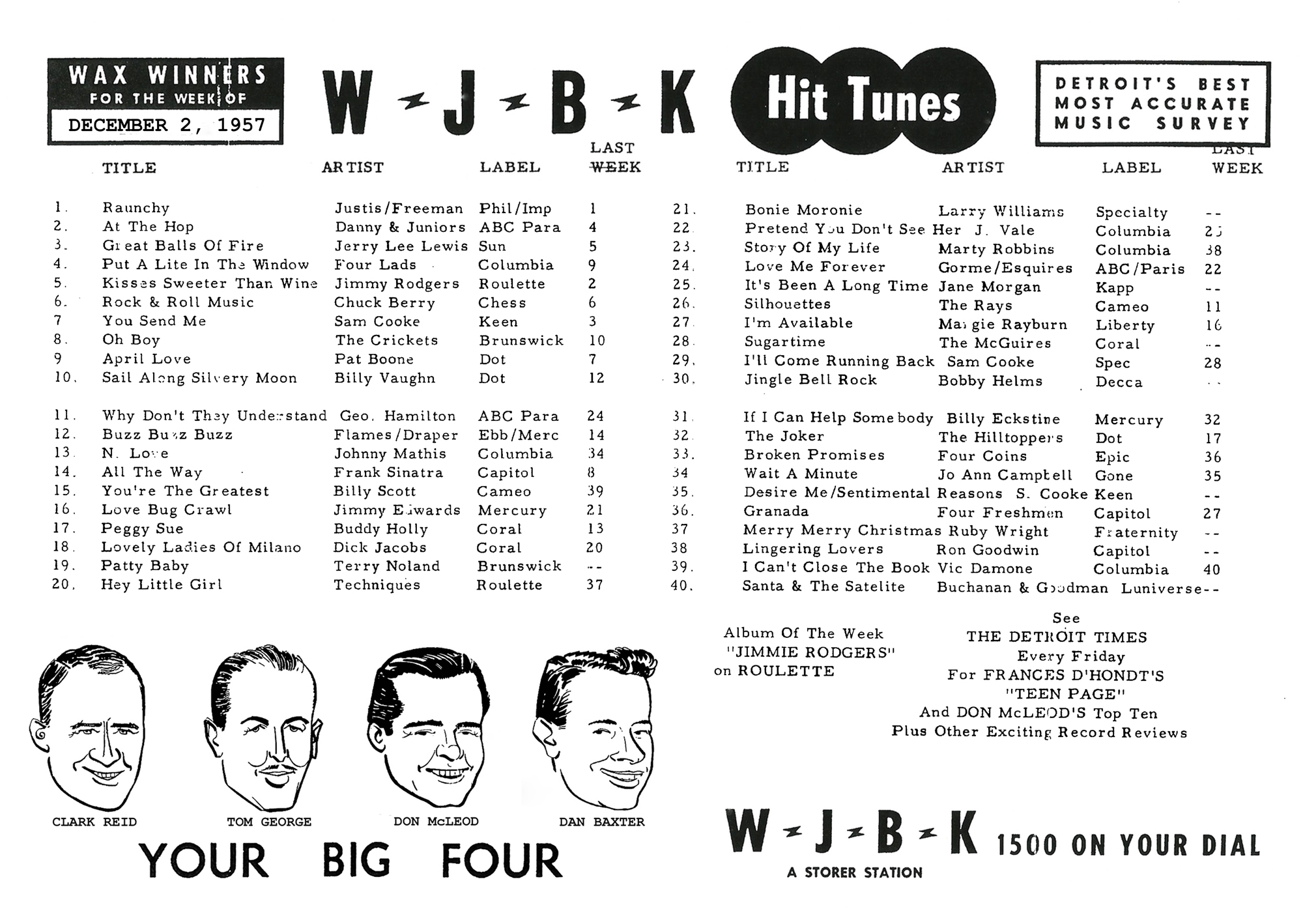
WJBK 1500 FORMULA ’40 SURVEY SOUNDS: 12/02/1957

WJBK RADIO 1500 December 2, 1957


WJBK DETROIT TOP 40. THIS WEEK

DECEMBER 1957

61 YEARS AGO

*****

The WJBK FORMULA 40 hits was compiled, tabulated and produced by Radio 1500’s Bob Martin and Rosemary McGann.

This survey was tabulated overall by each record’s popularity and its appeal, sales, listener requests and record airplays based on the judgement of WJBK Radio.

*****

Previewed for the week of December 2, 1957


A MCRFB VIEWING TIP

ON YOUR PC?To fully appreciate this WJBK Formula 40 Music Survey for the week of December 2, 1957 chart feature click on image 2x and open to second window. Click image anytime to return to NORMAL image size.

Click your server’s back button to return to MCRFB home page.


On your mobile device? Tap on chart image. Open to second window. “Stretch” chart across your device screen to magnify for largest print view.


WJBK RADIO 1500 December 1957

A SPECIAL THANK YOU

In Memory of George Griggs

___

Above WJBK music chart courtesy of Mrs. Patti Griggs and the George L. Griggs estate.


Loading

‘PAMS’ LEADER MEEK MAKES TOP 40 JINGLE . . . DECEMBER 2, 1967

From the MCRFB news archive: 1967

Meek Gave Top 40 Radio Its Identity


Dallas — Bill Meeks, Pams’ President, didn’t invent top 40 radio, but it’s quite likely that top 40 radio wouldn’t be where it is today if there hadn’t been a Bill Meeks. Meeks helped give top 40 radio its zing . . . its identification.

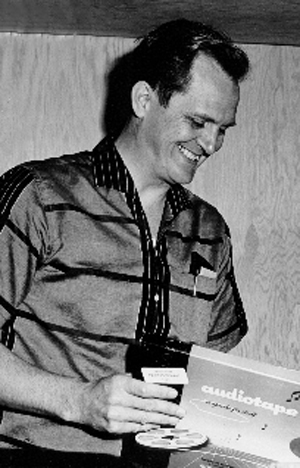
Bill Meeks circa 1958 (Photo courtesy PAMS Productions)

Meeks, a musician at home on saxophone, clarinet, of flute, got into the jingles-producing business while serving as air personality and salesman with KLIF here in 1947 . . . “the first jingles I ever heard of,” he said. He remembered one of those jingles as slashing on TV: “No worn-out old-time movies, no picture tubes to fail . . . ” It should be pointed out that Gordon McLendon, head of KLIF, was one of the pioneers in top 40 radio.

When Meeks began selling some of his jingles to other radio stations, “an odd thing began to happen. These stations began to climb in ratings.” In 1951, Meeks started Pams.

That first year of business, Pams did $300,000 worth of business. Meeks expects to close out 1967 with more than $1.5 million in business. Some of these will be new logos for all four of ABC’s new networks. Meeks was in town last week working on the project. In addition, he is branching out of the pop music field to also specialize in R&B and country music formats. Pams tailored the jingles used on WVON (R&B) in Chicago; the station climbed to No. 1 in a recent general Pulse audience survey and, as Meeks put it, “We were there when it happened.” Meeks is also going into the TV field on a larger basis.

Started In 1936

Meeks entered the radio business in 1936 with WRR in Dallas playing with a kid band called the Humdingers. The late Ben Riddle was a member of the band.They had a Sunday show on the station called “Primrose Parade” sponsored by an oil company. Then Meeks entered North Texas State. He continued to perform, substituting with bands like the Light Crust Dough Boys and the Cass County Kids. It was about this time he met McLendon, who encouraged him to become a KLIF salesman. KLIF had two salesmen, Meeks and a man named Bruce Collier. Meeks said he had Collier’s phone tapped “so I’d know who his clients were, I had to . . . he was really a slick salesman.”

While selling advertising, Meeks was also a deejay. At one point he had a CBS show starring one of his bands — the Circle Five Ranchhands — that originated out of Houston (the band would drive down from Dallas every Saturday). He also had a live show with a band doing a daily remote from a Dallas used car lot.

Employs 33

Today, Meeks operates a firm employing 33 (most of whom are professional musicians) and keeps two studios in Dallas busy. To illustrate the flexibility of his staff members, Rick Sklar, program director of WABC in New York, and Walter Schwartz, then general manager of WABC, once saw Pams’ Tommy Lloyd at work in the studio on trumpet. Later the same day, they saw and heard Lloyd playing in a band at the State Fair. That night, visiting the local LeVee nightclub, Schwartz and Sklar were surprised to see Lloyd , this time playing in a club band. He then saluted WABC right in the middle of “Sweet Lorraine,” by playing the WABC logo.

Meeks said that the turning point for Pams was in 1960 when he came up with a variable logo recording method to allow the various logos of stations to be recorded over the same big band instrumental, giving every station its own big band sound.

Besides having jingles packages in every major market in the United States, Pams products are in countries like Australia, Great Britain, Canada, Hawaii, Mexico, and South America. The firm just completed logos for the new BBC pop music programming service in England. END

___

(Information and news source: Billboard; December 2, 1967)


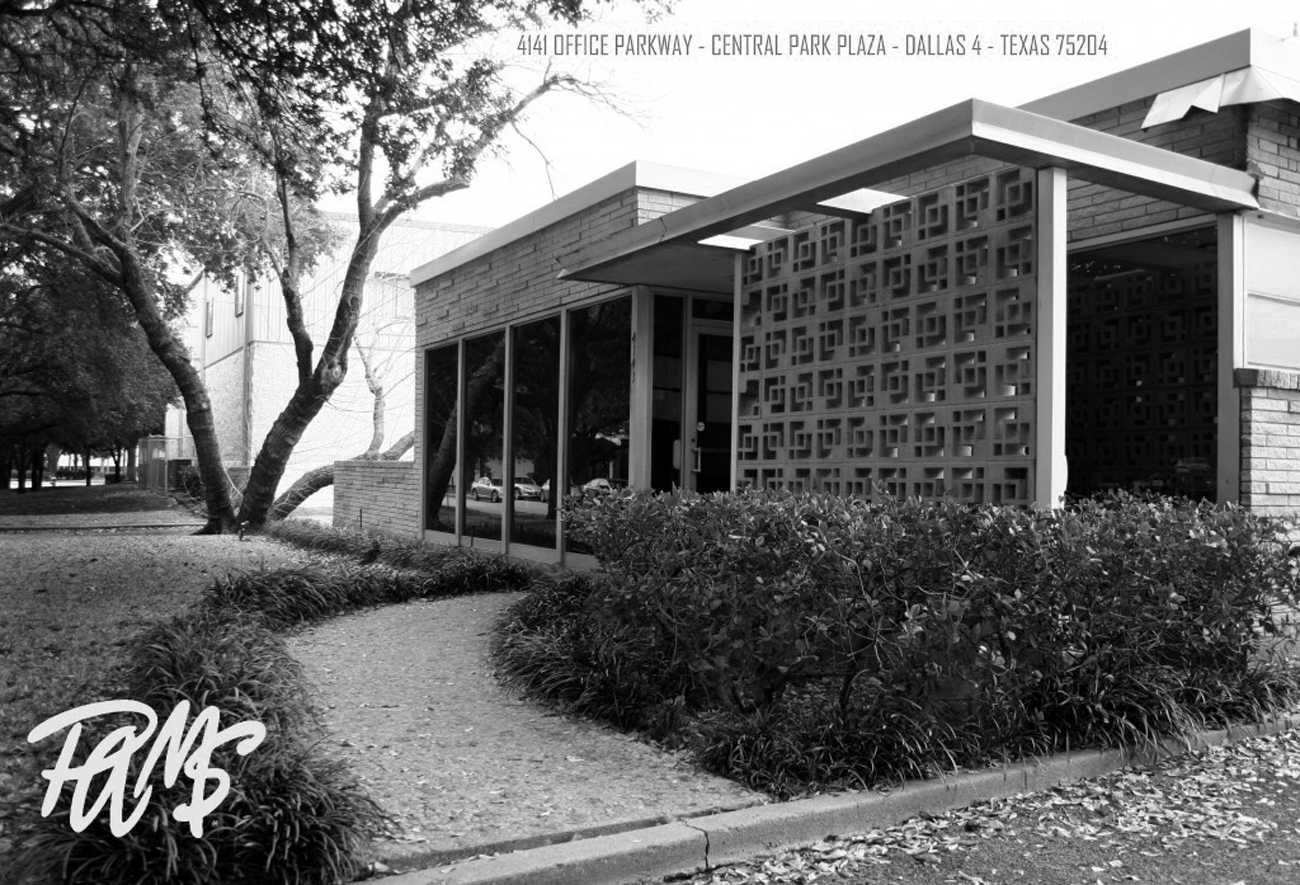
The legendary PAMS facility with office and studios, Dallas. PAMS: Production, Advertising and Merchandising Service (Photo courtesy PAMS, Dallas)

Loading

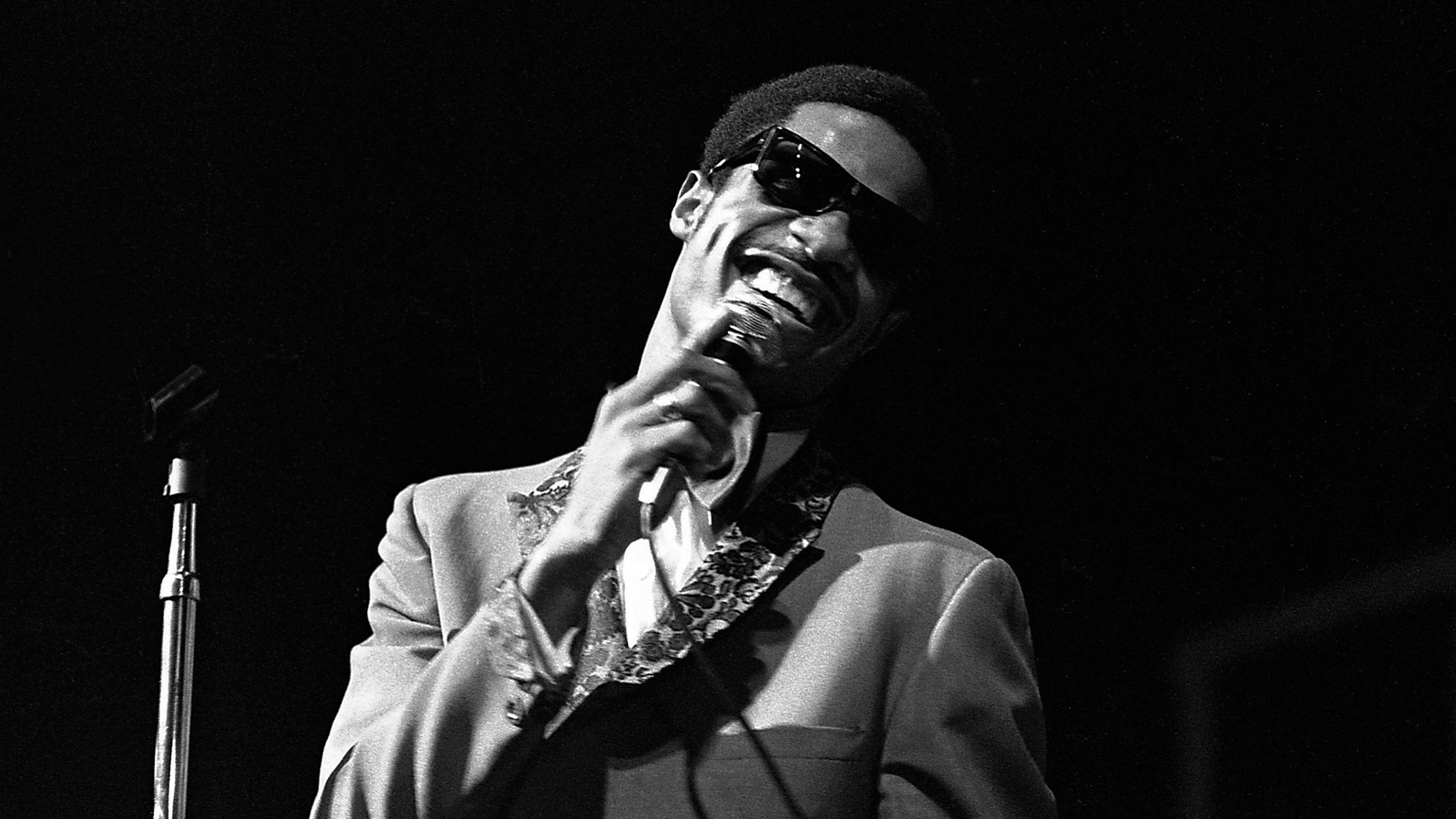
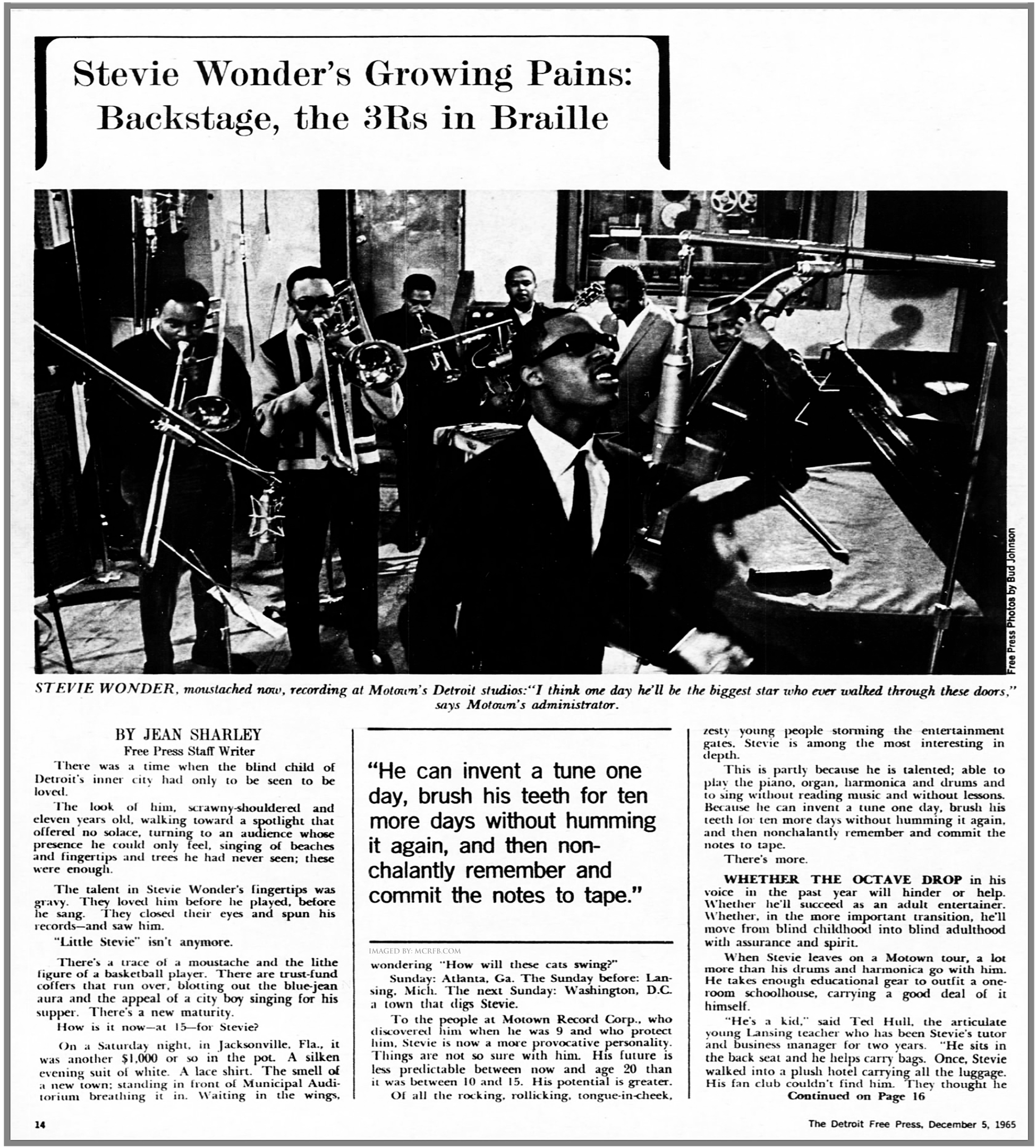
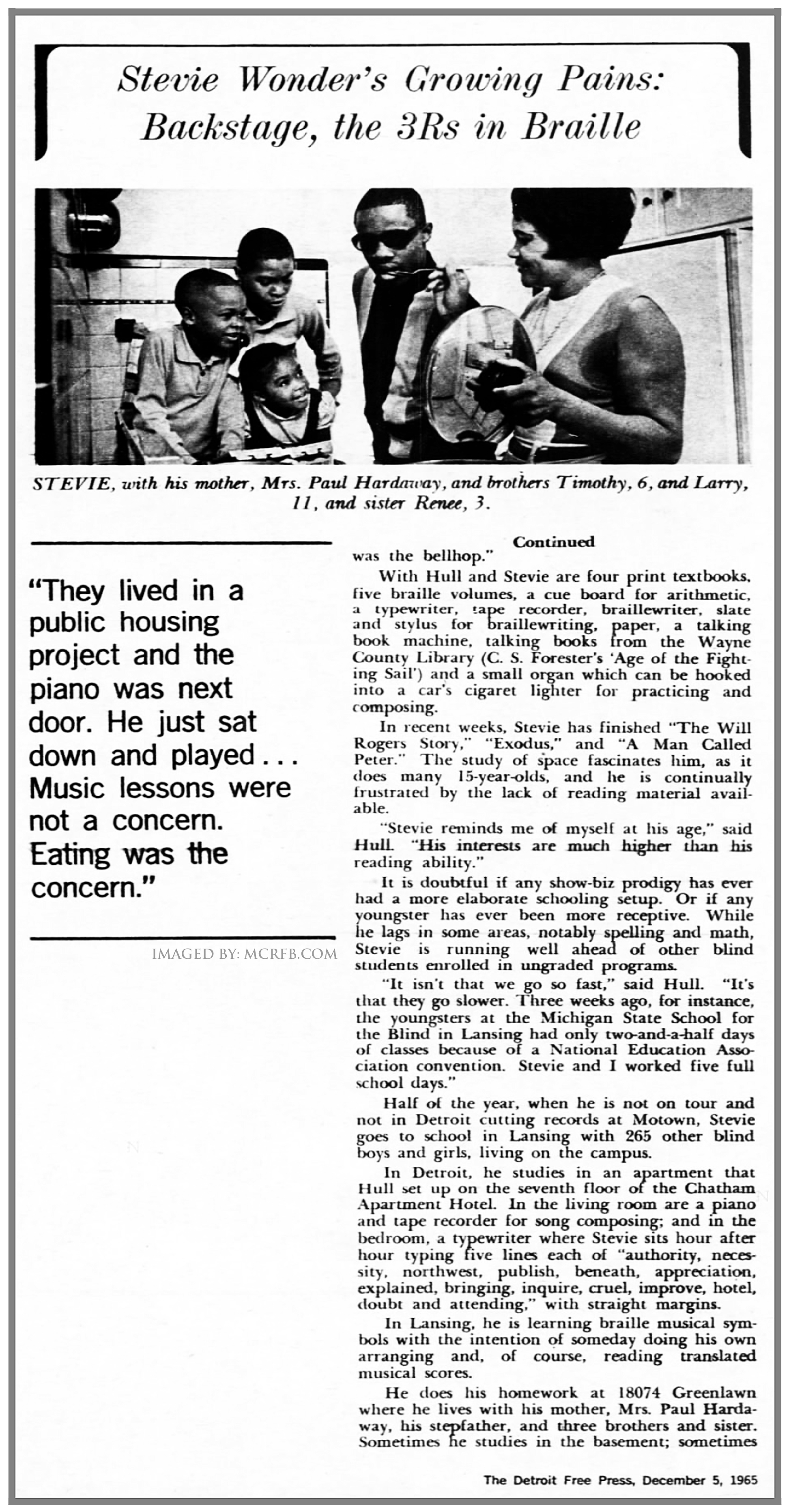
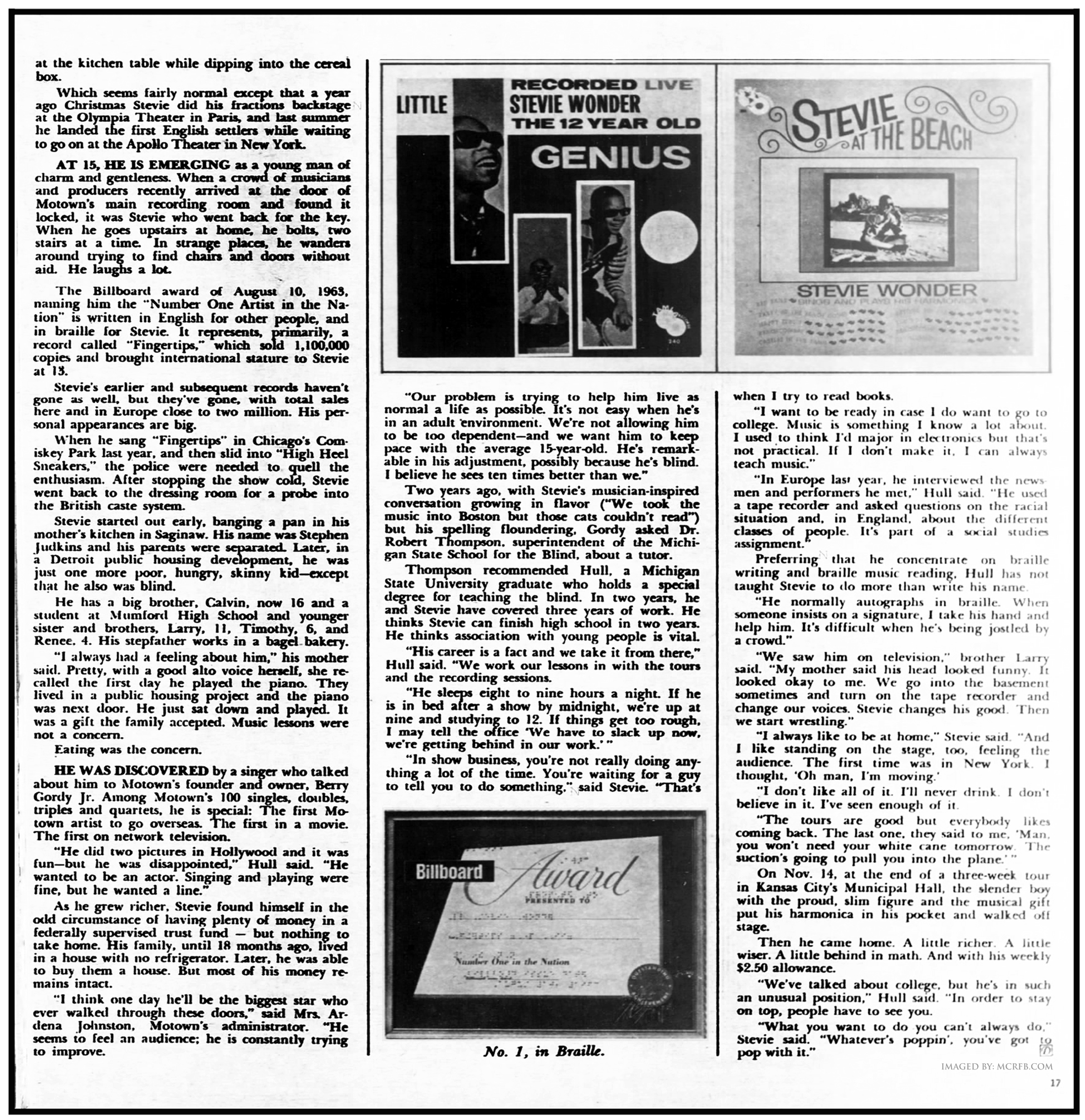
MOTOWN ’65: A STEVIE WONDER NEWS PRINT FEATURE!

Detroit Free Press December 5, 1965 (a.)

Detroit Free Press December 5, 1965 (b.)

Detroit Free Press December 5, 1965 (c.)


Sunday, December 5, 1965

A MOTOWN MONDAYS NEWS PRINT FEATURE

___

Above article is courtesy freep.com newspaper archive. Copyright 2018. Newspapers.com.

The above featured Motown ad article was clipped, saved, and imaged from the credited source by Motor City Radio Flashbacks


A MCRFB VIEWING TIP: On your PC? You can expand this Motown/Fox newsprint ad from 1963. 

For a larger detailed view click above image 2x and open to second window. Click image anytime to return to NORMAL image size.

Click your server’s back button to return to MCRFB.COM home page.


ON YOUR MOBILE DEVICE? Tap on image. Open to second window. “Stretch” image across your device screen to magnify for largest print view.


Missed any of our previous MOTOWN related news prints? GO HERE


Loading

CKLW-AM BACK ON THE RADIO: MIKE KELLY


CKLW RECALLED ON MOTOR CITY RADIO FLASHBACKS

CKLW-AM 800 * 1973 * MIKE KELLY


Mike Kelly CKLW aircheck date: Saturday, February 17, 1973

___

NEW! A special THANK YOU to Mike Lockhart, of Ferndale, MI, for recently donating this CKLW-AM radio aircheck to Motor City Radio Flashbacks!

___

* THE MIKE LOCKHART COLLECTION *


CKLW Mike Kelly 1973


Loading

A CLASSIC LP STANDARD: JACK JONES LP HITS BIG, ’63


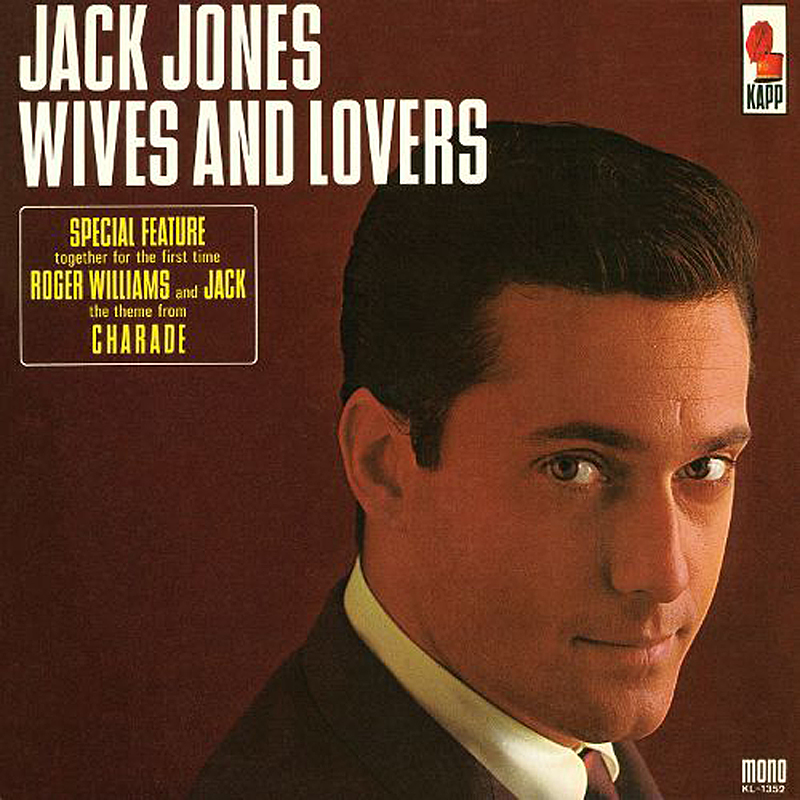
WIVES AND LOVERS * Jack Jones * KAPP RECORDS (1963) [COMPLETE ALBUM]


A CLASSIC 1963 Easy-Listening ALBUM MEMORY


Jack Jones reached the zenith of his commercial fame with his late-1963 smash,Wives And Lovers, “Burt Bacharach and Hal David’s velveteen paean to chauvinism, pre-era domestic bliss.

Jones eighth album since 1959, the accompanied LP boasts a similarly old-guard charm, recruiting arrangers such as Marty Paich and Ralph Carmichael to collect a delightful collection of string-sweetened, jazz-influenced ballads perfectly attuned to Jones’ rich, crystalline vocals. An unusually interpreter, Jones approaches standards likeFly Me To The Moon” and “Come Rain Or Come Shine” with intelligence and class, never succumbing to pathos — the purity of his singing never fails to astound.

His 1963 single, as titled on the album, earned Jones a Grammy Award for Best Vocal Performance in 1964. In recording “Wives And Lovers,” Jones’ vocals is accompanied by an orchestra arranged and directed by Peter King. On the B-side of the single, another Jones standard from 1963, “Toys In The Attic.

The single peaked at #14 on Billboard in December 1963. The complete track listing for this album can be found here.

Source: AllMusic, Discogs, Wikipedia


JACK JONES (Press Photo; 1963)

Loading