Where would we be without the internet today? Three days!
Our internet provider (Comcast) shut down completely (on Sunday) during a severe thunderstorm we experienced here in Detroit. Therefore, we were set back not having posted any new features on this site for a couple of days.
But Comcast finally came through for us (sometime during the 10 AM hour) today, Tuesday.
And so we are back in the groove on Motor City Radio Flashbacks . . . .
WGPR Making Waves in Detroit with Increased Remote Broadcasting
DETROIT — A radio station that’s “kinda movin’ ” gets listeners and WGPR-FM is a station constantly on the move. Floyd M. Jones, station manager, said the station is “No. 1 among FM stations and No. 3 among stations – period.”
Probably the strongest example of how this station moves, however, is a countdown of its remotes – 36 a week. Jones handles a two-hour daily, three – hour Saturday evening jazz record show from the Disk Jockey Lounge. Dan (Bull Frog) Harrison does an rhythm and blues record show from the Chit Chat Lounge. DJ Larry Dixon may handle a random remote broadcast, but nothing steady at the moment; however, he does have a weekly record hop.
The 50,000-watt FM station broadcasts about 20 hours a day covering a radius of 75 miles. One reason for the tremendous success enjoyed by the station, Jones said, is that some 87 per cent of Detroit’s Negro element has FM radios. “But it’s more than that. We’re creating the image here that FM is more than just a background medium. We’re putting out a new sound.”
While the station programs record shows for Detroit populace such as Greeks, Italians, Polish and Mexican, the main portion of each day is used with rhythm and blues programs – a total of three programs a day for a total of seven hours. Jazz takes up about four hours each day. Gospel music is played early in the morning. Sunday is devoted to remote broadcasts most of the day from local churches. The station employs about 40 people. Bob Longwell is the station’s general manager.
Another reason the station is moving, according to Jones, is that programming and air personalities aims at three important and large audience segments. “I take care of the jazz fans,” Jones said. “Larry Dixon is a teen-oriented personality. And Bullfrog is for the rhythm and blues fans.” END
_______________
Information and news source: Billboard; July 17, 1965
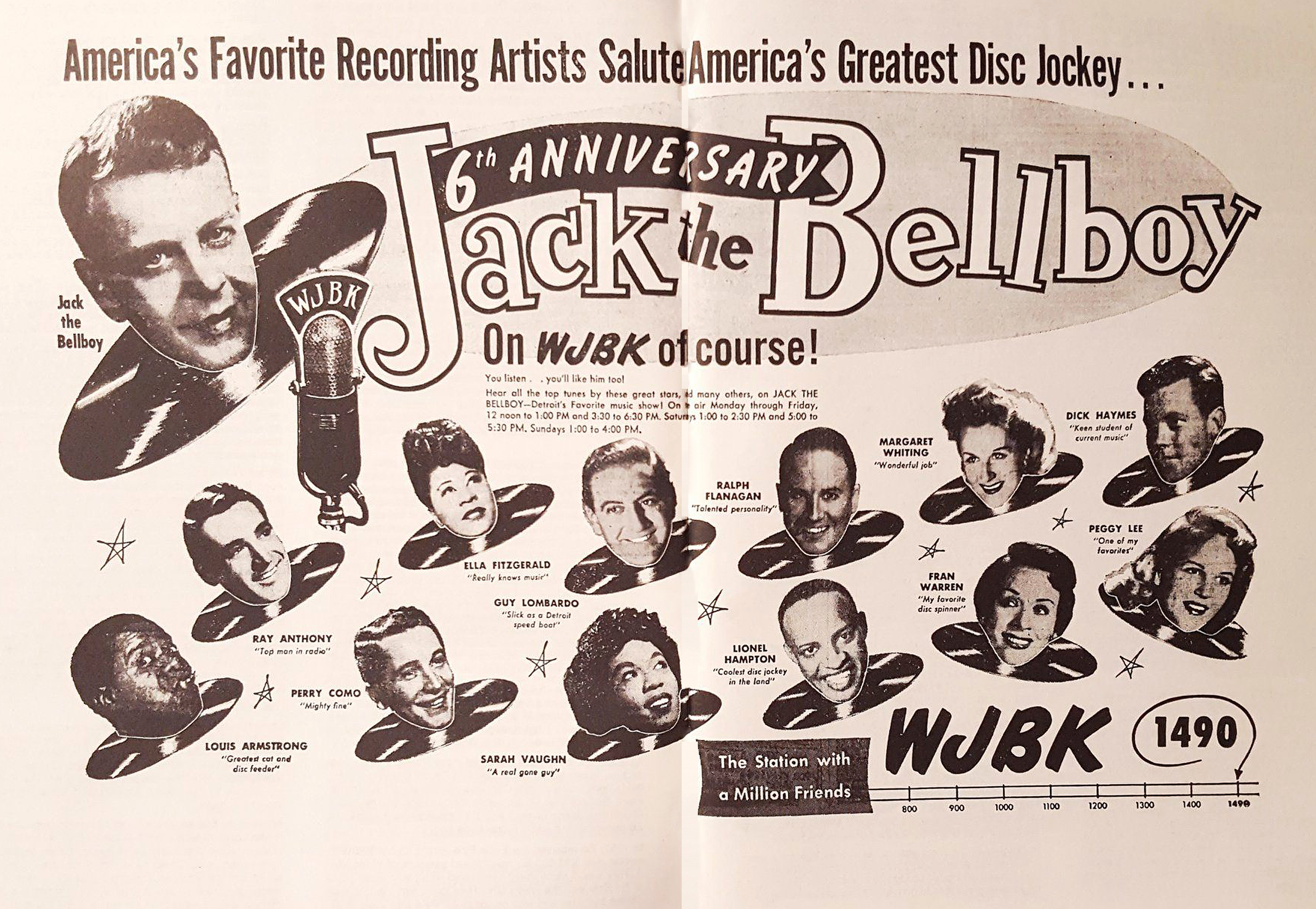
A WJBK Radio 1500 trade ad. Commemorating Ed McKenzie’s 6th year at the station, 1951.
JACK THE BELLBOY
—ED McKENZIE—
_______________
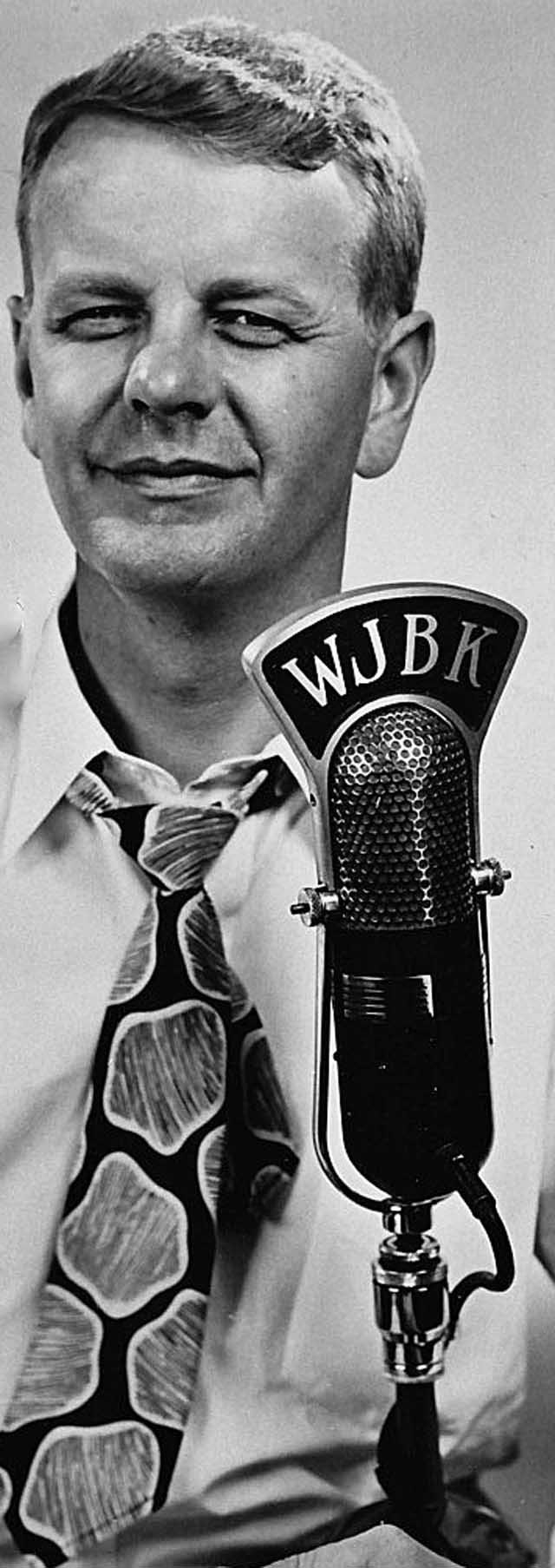
Ed McKenzie 1950
[Note: Industry ad for Jack the Bellboy, circa 1951, reprinted in the International Association of Jazz Record Collectors, (IAJRC; Summer 1995) spotlighting Detroit DJ Ed McKenzie].
Ed McKenzie had been with WJBK since 1937. During WWII, he began to take over announcement chores for the short-handed station at the time, and eventually he became both engineer and the station’s chief announcer.
McKenzie did his first stint as a disc jockey in 1945. The name Jack the Bellboy was adopted from a favorite recording from Lionel Hampton.
He left WJBK for WXYZ, and will start (4-6:00 p.m.) Monday, February 4, 1952. ABS, owner of the station, also expressed of their plans to syndicate his show on the American Broadcasting Systems.
A special studio will be built for him at the Michigan Mutual Building, where WXYZ has its offices.
(Source: The Detroit Free Press; January 17, 1952)
— ACKNOWLEDGEMENT —
A special THANK YOU to ‘Radio Muze” (as he prefers to be only called) of Los Angeles, California, for having shared this WJBK Ed McKenzie spread with Motor City Radio Flashbacks!
A MCRFB VIEWING TIP
ON YOUR PC? To fully appreciate this WJBK trade ad click on image 2x and open to second window. Click image anytime to return to NORMAL image size.
Click your server’s back button to return to MCRFB home page.
ON YOUR MOBILE DEVICE?Tap on above image. Open to second window. “Stretch” chart across your device screen to magnify for largest print view.
Although the Contours never quite repeated the extraordinary success of “Do You Love Me,” they returned to the charts four times during 1963 and 1964 starting with “Shake Sherry.” They also charted on the R&B Charts with the “B-side” to “Can You Jerk Like Me,” the Smokey Robinson-penned “That Day When She Needed Me.”
In 1964, Billy Hoggs, Joe Billingslea, Hubert Johnson, and Sylvester Potts all left Motown.
Berry Gordy hired Council Gay, Jerry Green and Alvin English to back Billy Gordon, making the Contours a vocal quartet (with Davis remaining the group’s guitarist throughout their stint at Motown). During this period, tracks recorded by both line-ups were being put together for a second album for Motown entitled The Contours: Can You Dance (Gordy 910). However, for unknown reasons, this album was never released by Motown.
Within a year, Sylvester Potts returned to the group (replacing Alvin English), and Billy Gordon departed shortly thereafter. Gordon was replaced by Joe Stubbs, brother of Four Tops lead singer Levi Stubbs. Stubbs soon quit the act and was replaced by Dennis Edwards. Stubbs would later go on to become lead singer of the 1970s non-Motown R&B group, 100 Proof (Aged in Soul).
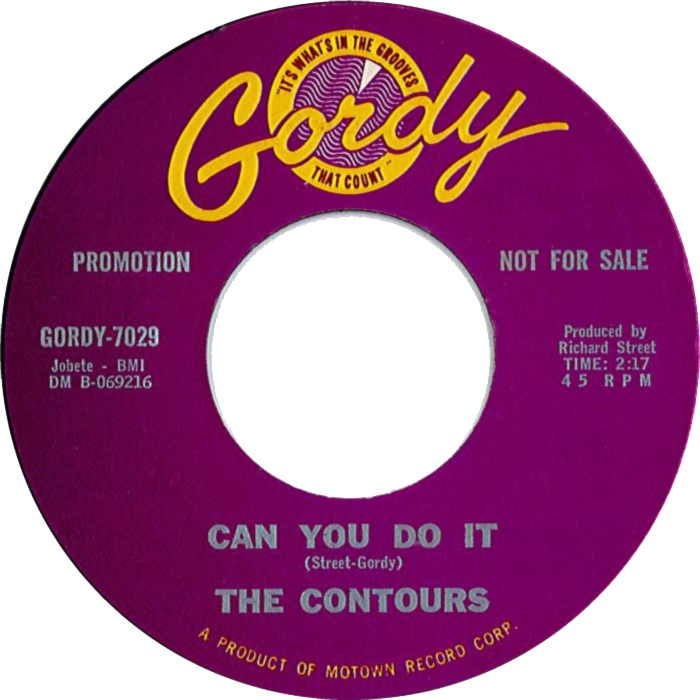
The group produced three R&B hits on the Gordy label in 1964. “Can You Do It” (#16 R&B); “Can You Jerk Like Me” (#15 R&B); “That Day When She Needed Me” (b-side of “Can You Jerk Like Me,” No. 37 R&B).
In 1964, The Contours comprised of Billy Gordon, Huey Davis, Council Gay, Jerry Green and Alvin English.
_______________
Source: The Contours; Wikipedia
A MOTOWN/CASHBOX ad.Highlighting The Contours’, “Can You Do It” (March 1964)