

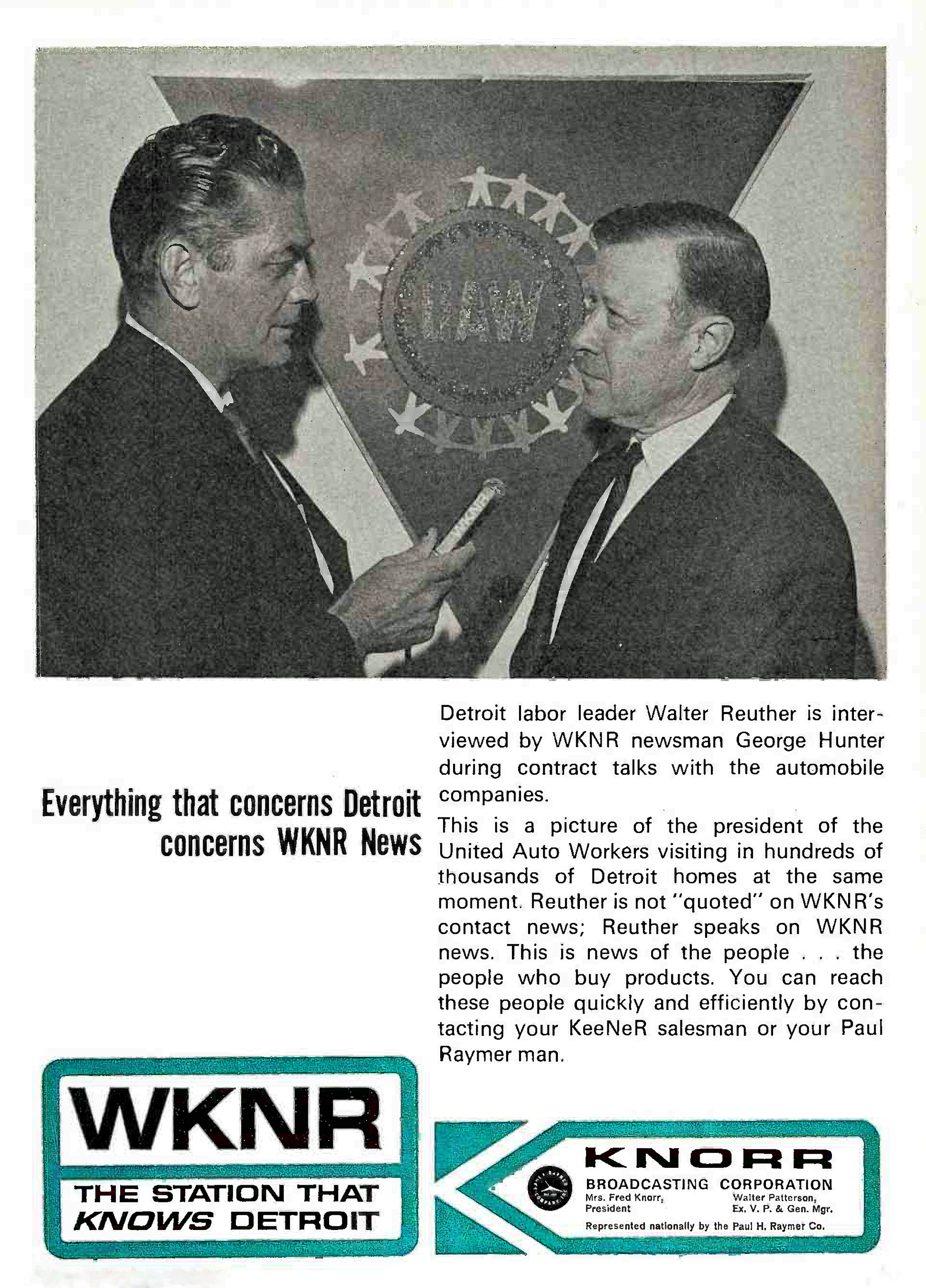
 From the MCRFB NEWS archive: 1964
BRITISH ACTS INTEREST WANE IN U.S.; CAUSING PROMOTERS FINANCIAL DRAIN
HOLLYWOOD — Concert promoters are taking a second look at the British bands as financial reports indicate that the romance between the long-haired lads and their adolescent admirers may be cooling — at least at the box office.

Ironically, America’s Top 40 radio stations are playing the British groups with dominating force, indicating that what happens in the concert arena has no relation to what makes a station’s playlist.
In a recent Las Vegas gig, the Dave Clark Five drew around 3,000 teens in the 8,000 seat Convention Center for an $8,000 gross, causing the Thunderbird Hotel and Vegas’ radio station KENO to suffer an unexpected loss. The same group had grossed $10,000 in Minneapolis but local promoter Ray Colihan lost $4,000 on the date. He paid the British band $25,000 for two dates, one in Des Moines. It was also reported that Colihan lost a larger sum promoting a concert with the Rolling Stones earlier this year.
The Rolling Stones cost one Chicago promoter by the name of Ed Pazdur $5,000 when they bombed in Cleveland earlier in November. The group had been booked in the 11,000 seat Public Auditorium with a $44,000 top gross potential.
The Rolling Stones show was in trouble when city fathers took exception to the news that young girls had withdrawn their savings from a bank and flown to England to visit the Beatles. Cleveland’s mayor Ralph Locher decreed that rock and roll contributed nothing to the city, casting the Rolling Stones show in a bad light. Pazdur has the Dave Clark Five booked for Thursday, December 17.

Other reports have reflected the same mood elsewhere. A British rock show in Ottawa, Ontario, fell on it’s face when the unit only drew 1,957 paid admissions in the 6,000 seat YMCA Auditorium. The bands headlining the show were Billy J. Kramer & The Dakotas, along with Gerry & The Pacemakers on the billing as well.
It is known that American publishers and now the promoters are concerned over the slipping box office appeal of certain British acts who are presently touring the concert circuit here.
As one publisher had stated, “This situation ought to be brought out into the open so that the disc jockeys would be fully appraised as to what’s happening. They’re playing the British records like they’re the only ones selling. But these same acts are bombing in person.” END
___
(Information and news source: Billboard; December 12, 1964)
 From the MCRFB NEWS archive: 1967
Drake Blasts Recording Reps for Tabbing Him Tight-Play Addict
NEW YORK — Bill Drake, program consultant who has been just hired to consult all RKO General radio stations, including CKLW in Windsor/Detroit, lashed out at record reps who would tag him with the image of a tight playlist artist.

Drake, who scored ratings successes at KFRC in San Francisco and KHJ in Los Angeles, was in New York last week trying to work his magic on an FM station — WOR-FM, a stereo operation that had already made a sizable dent in New York ratings with a rock ‘n’ roll format. One of the first moves Drake did make was hire Gary Mack, formerly at KHJ, at WOR as program director of the station, replacing Art Wander.
As for other changes at the station, Drake said he would would try to improve the presentation of the music and the content. “The station will continue to play a lot of diverse album music, aiming at the 18-35 age group. It’s going to be rock, using every type of LP cut. Oldies would have a lot of influence…. a lot of Motown product, for example.” He said that other radio stations under his banner have been playing album cuts, “but to take an album and put it in the control room and say the deejay can play from it, is the same fallacy a lot of stations make in saying Sinatra is a super star. You don’t play Sinatra for the sake that he’s Sinatra; he’s had some bad cuts too. You don’t play Dylan for the sake he’s Dylan, Sinatra for the sake he’s Sinatra, Motown for the sake they’re Motown,” Drake concluded.
“The object is to play the good Dylan, the good Sinatra,” he said. And a lot can determine this. People working at the various stations guided by Drake listen to every cut of every LP, every single. Drake credits his success to “hard work and the good people working with me in striving for total success.”
Swap Information
Information between the stations is exchanged in writing, there are conference telephone calls on the music itself, as station personnel all exchange playlists. “But the music playlists at various stations vary an awful lot. This actually gives us the opportunity, contrary to opinion, to expose and test nine times as many records as anyone else. If a radio station plays three new different records each week that the other stations are not playing, this would run to 27 new records each week.”
Basically, he felt his radio station policy isn’t just to play the top few records . . . but he does advocate not playing “losing” records. “The object is to play winners. It’s good for us, it’s good for the record companies. If you consistently have weak records on the air, it’s obviously going to limit the amount of exposure you can give a strong record.”
“I could never understand why record companies wouldn’t be irritated because their good product was being hurt by the amount of weak product sometimes played.”
Fresh Product
Drake does believe definitely in playing new records, saying his stations were spinning LP cuts by the Jefferson Airplane before the group hit paydirt with their recent single, “Somebody To Love.” “You’ve always got to have fresh new product on the air… good new records… whether by some new or known artists. Otherwise your station winds up with a staleness.”

Playing records by and for hippies will not lead to a successful radio station; he felt. he believes the whole of the San Francisco movement is a myth. Request radio is also too narrowly aimed . . . “What’s wrong is that these stations get the teenage listeners. You want them too, but not exclusively. Younger kids are the only ones, however, who have the time and patience to dial for a particular song they want to hear on the radio. They aren’t going anywhere anyway. Because they have more time on their hands than older people have.“
The object of winning radio is to please everybody without going after just them. “You play ‘Happy Together’ by the Turtles, ‘You Keep Me Hangin’ On,’ by the Supremes . . . those are monster records everybody likes.”
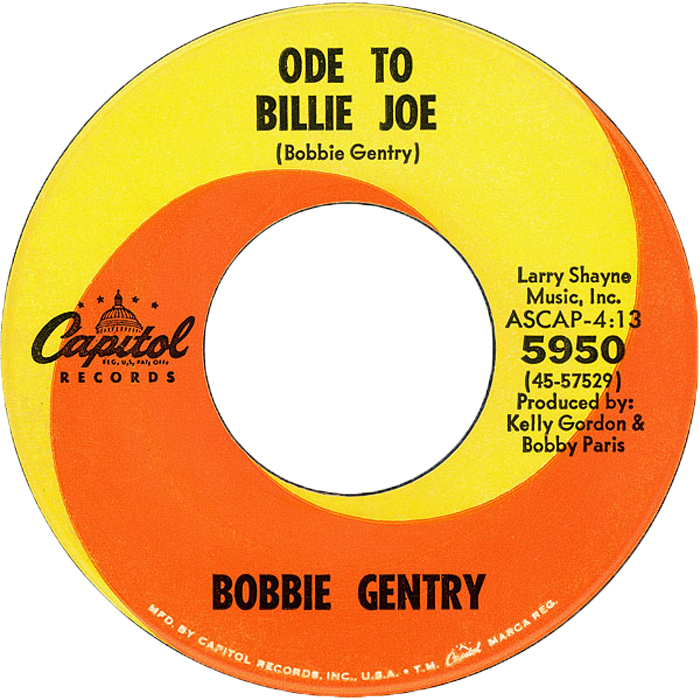
Still, aside from the “monster” policy, Drake’s stations for the most part, do allow for some leeway. Tom Rounds, he said, picked up on “Ode To Billie Joe” early and began playing it under the assumption that it was going to become a monster hit on the chart. The record hit the chart a week ago like gangbusters and is still climbing.
Obviously, so is Bill Drake, currently rising fast with WOR-FM in New York and CKLW-AM in Detroit. END
___
(Information and news source: Billboard; August 12, 1967)

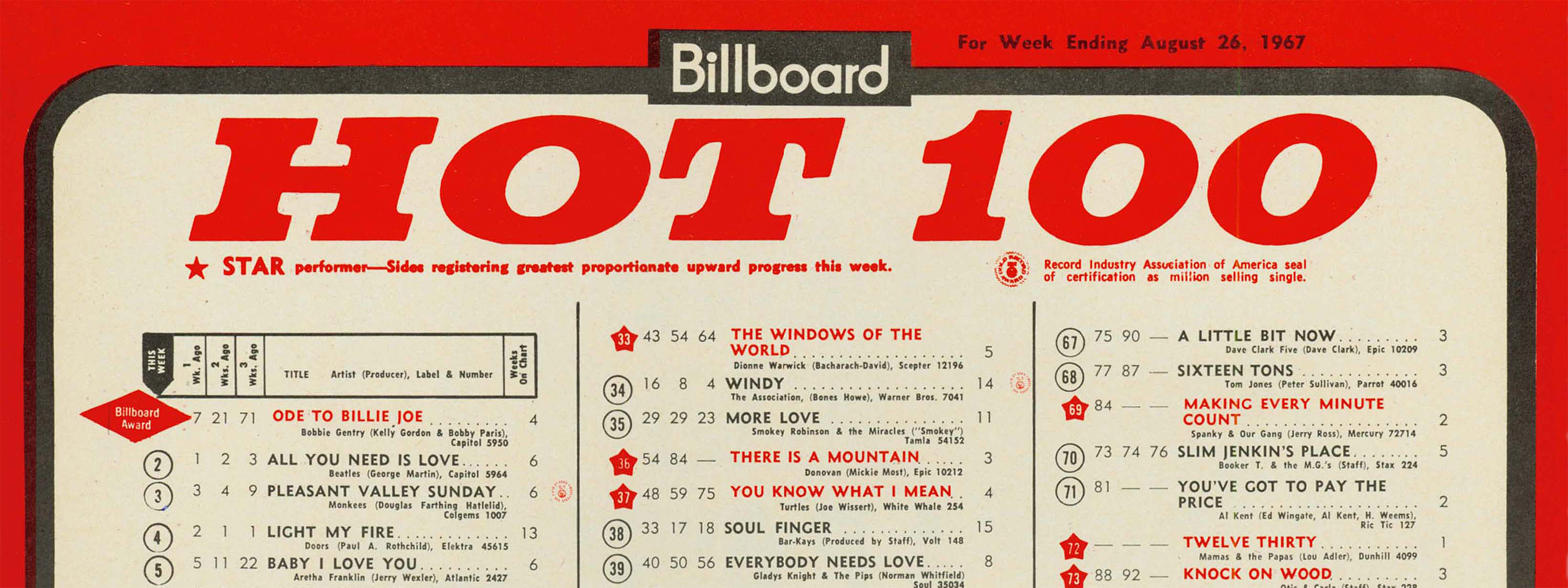
(Click on chart image 2x for detailed view)
___
FOURTEEN WEEKS on the singles chart, “Ode To Billie Joe” by Bobbie Gentry peaked this week at No. 01 (4 weeks) on the Billboard Hot 100, week August 20 through September 16, 1967. (source: Billboard)
___
MCRFB Link: For the previous No. 1 record in the U.S.A. 1967 GO HERE.


___
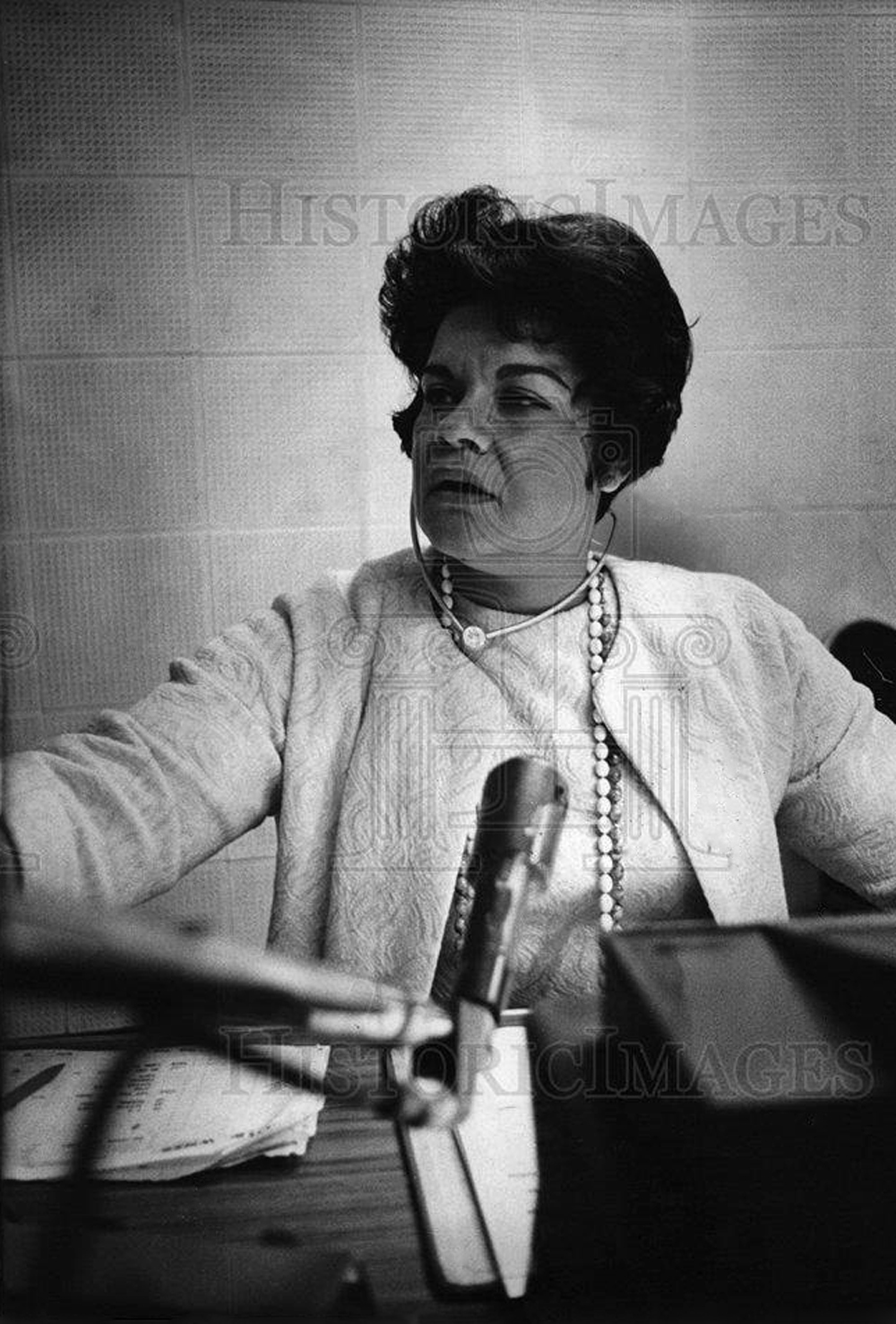
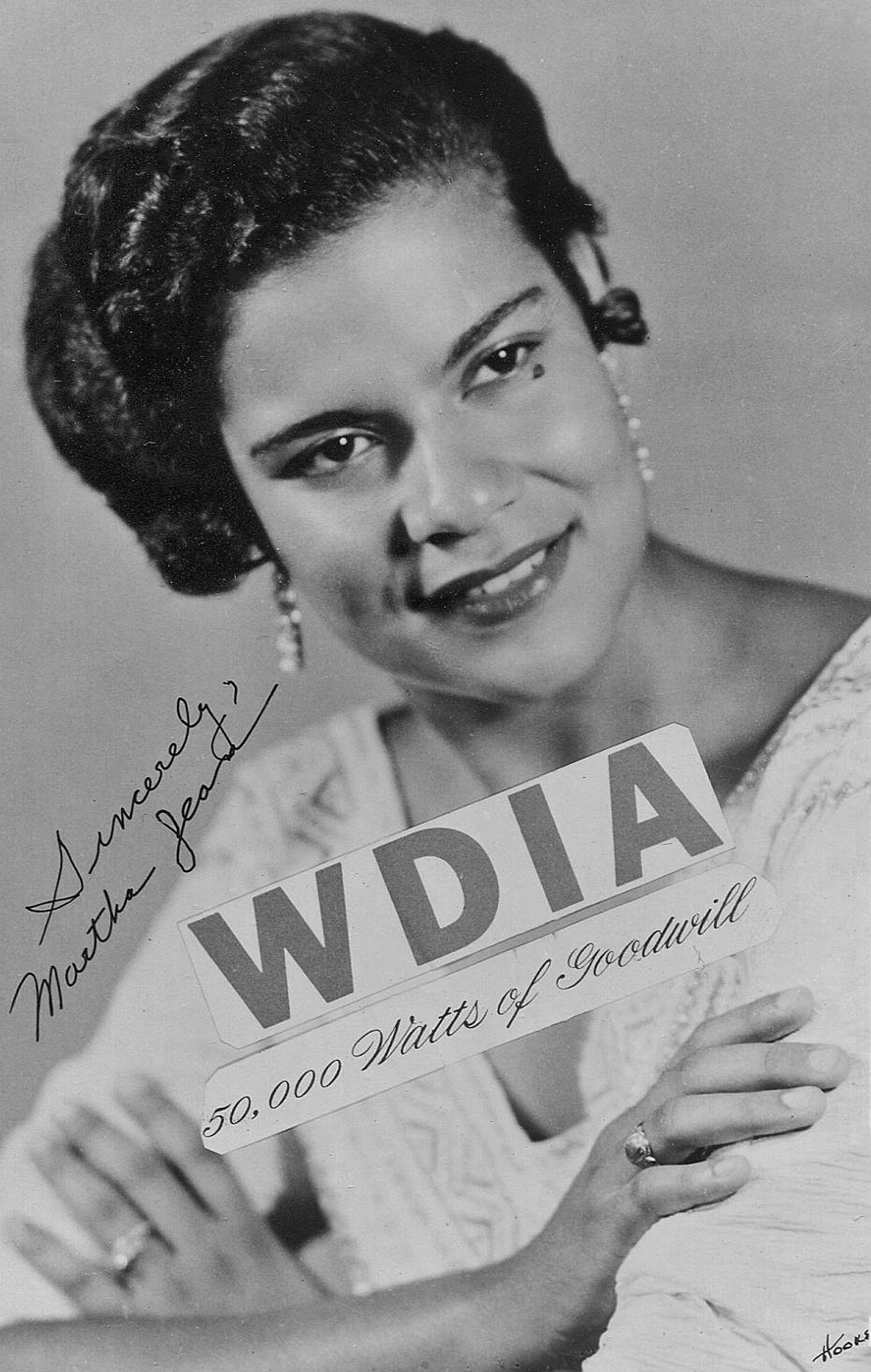
A special THANK YOU to Diane Steinberg Lewis, daughter of Martha Jean Steinberg, for recently sharing with Motor City Radio Flashbacks this lovely portrait of Martha Jean. August 12, 2017.
___
A TRIBUTE TO THE QUEEN
___
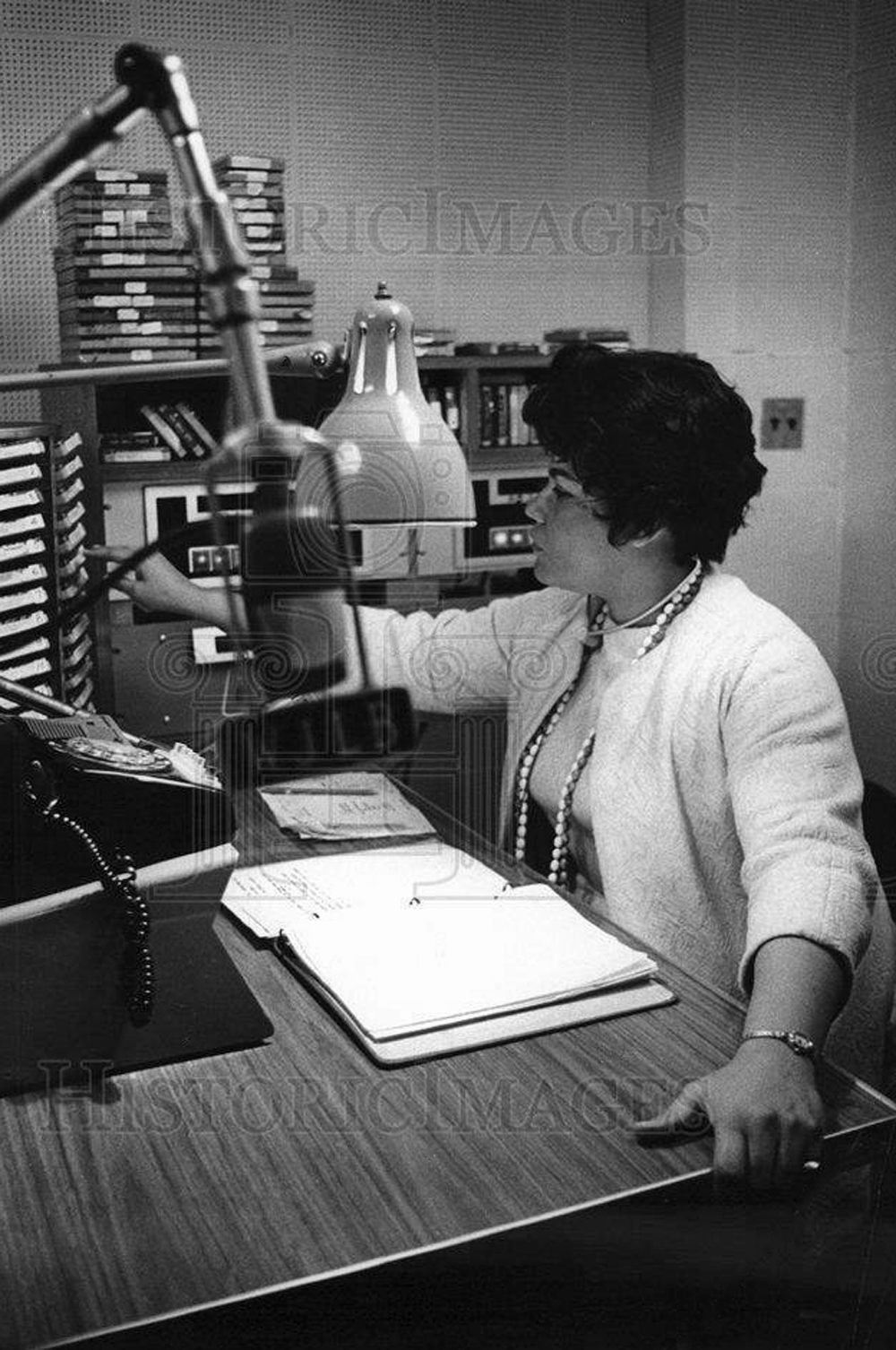
In the early 1950s, Martha Jean, would become one of but a few female broadcasters in the country working radio “on-the-air.” She landed her first DJ stint in broadcast radio when she was hired at Memphis’ WDIA in 1954.
In 1963, Bell Broadcasting in Detroit, WCHB, hired Martha Jean from Memphis’ WDIA. After three years on the radio there, she left WCHB for Detroit’s WJLB on October 24, 1966.
Fifty years ago, during the Detroit riot in July 1967, in her personal attempt to quell the widespread civil disturbance and “calm the citizenry” — Martha Jean convinced WJLB management to cancel all scheduled programming — thus allowing her to remain on the air for an unprecedented 48 consecutive hours.
The legendary soul radio personality Martha Jean, known as “The Queen,” remained a broadcasting staple for over four decades while in the Motor City. During her decades’ reign on the radio airways here she became a formidable voice for Detroit and its inner-city core. In 1982, she purchased her own radio station, thus, becoming its sole manager thereby having divested all prior control of operations for WQBH (formerly Detroit’s WMZK).
She remained there on the air until the day she passed away, January 29, 2000.


___
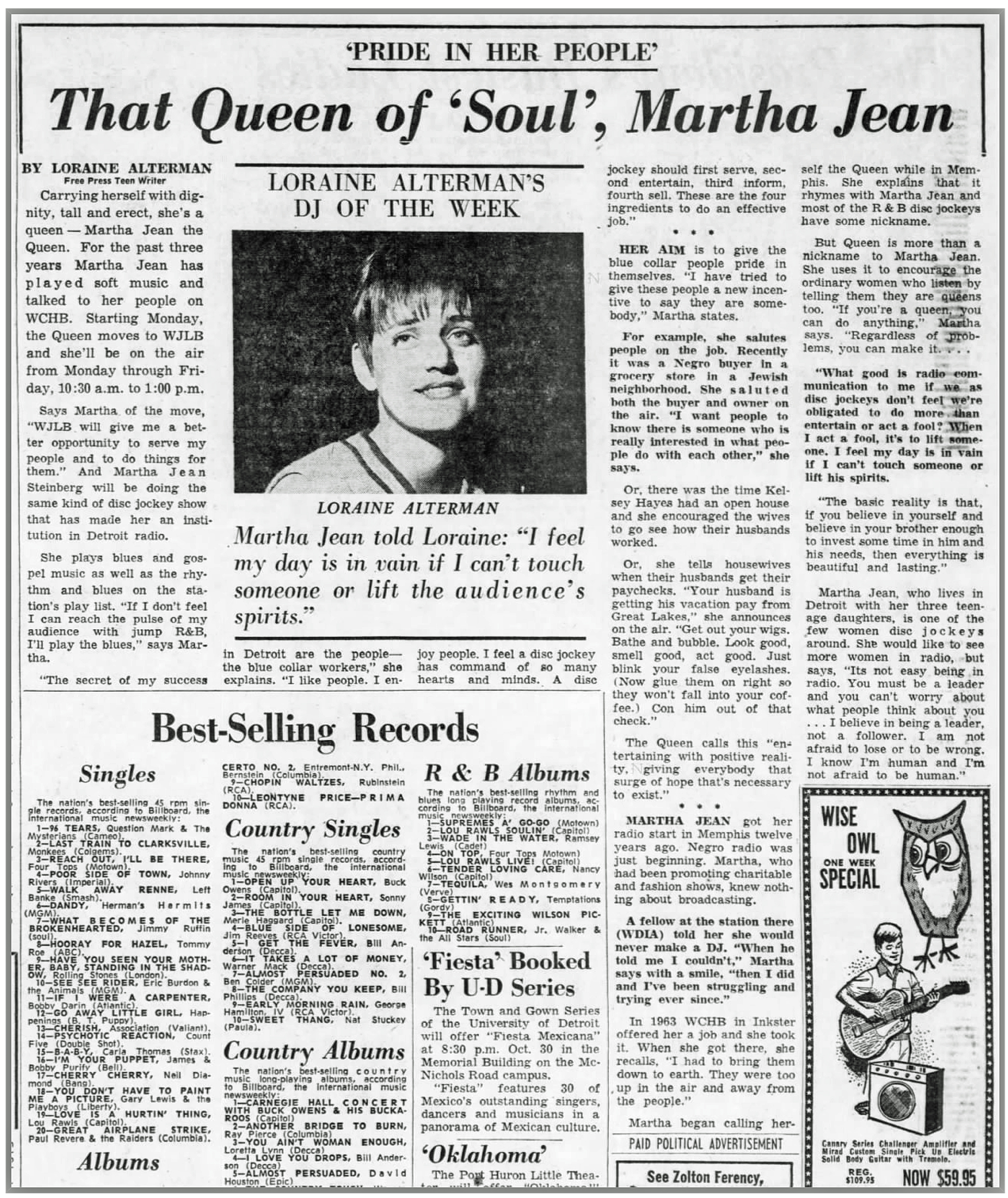
DETROIT FREE PRESS: WCHB-AM ‘That Queen Of ‘Soul,’ Martha Jean’
(Above WCHB related article is courtesy freep.com newspaper archive. Copyright 2017. Newspapers.com).
A MCRFB viewing tip: On your PC? You can read the entire 1965 article! For a larger detailed view click above image 2x and open to second window. Click image anytime to return to NORMAL image size.
Click your server’s back button to return to MCRFB.COM home page.
On your mobile device? Open to second window. “Stretch” image across your device screen to magnify for largest print view.
Missed any of our previous ‘Detroit Radio Back-Pages‘ features? GO HERE.


THE KING IS GONE * RONNIE McDOWELL * 1977
