MUSIC BUSINESS | DANCERS SIZZLES on ROCK & ROLL SHOWS . . . APRIL 3, 1965

Choreographers have brought the latest dances to the homescreen on “Hullabaloo,” “Shindig,” and “Hollywood a Go-Go”


HIP AND EXCITING. The hippest, the wildest, the most exciting and most avant garde dancing being done on TV-and perhaps anywhere else today-takes place every week on the rock and roll TV shows. We are talking about “Shindig”, “Hullabaloo,” “Hollywood a Go Go,” The Lloyd Thaxton Show, and local shows in large cities like New York, and Hollywood.

It’s true of course that TV has always featured dancing on the big time shows, starting way back with the old Sid Caesar-Imogene Coca show, the Jackie Gleason Show, and the Perry Como Show, for example. Gleason opens all his shows with the June Taylor tap dancers. But the choreography on these shows is old hat compared to “Shindig” or “Hullabaloo,” almost like comparing the Busby Berkley dances in the old Dick Powell movies to the Jerome Robbins dances in “West Side Story.”

It’s doubtful if even “Shindig” producer Jack Good envisioned the effect that the “Shindig” dancers would have on TV, and TV critics, when the pioneer live TV show kicked off last September. Up until then rock and roll TV shows, like the old Dick Clark daily bandstand show, featured youngsters doing the latest dances in a casual, almost amateur-like way.

“SHINDIG” STARTED IT. “Shindig” was different from rock & roll TV shows that had preceded it in many ways. It featured a large band, smart camera work, and a lineup of a dozen attractive young girls who performed up-to-date dances behind the singers and instrumentalists on the show. This was similar to the rock and roll TV shows that Good had put on in London for both the BBC and commercial TV.

“Shindig’s” success inspired “Hullabaloo,” a slightly different show in some respects but still adhering generally to the rock and roll format. “Hullabaloo” however, went “Shindig” one better. It not only featured a lineup of dancers, but the dancers were featured themselves in one or two routines each evening. And the premiere “Hullabaloo” show spotlighted a dramatic young lady named Joey Heatherton, whose dancing that night created press comment for the show from coast-to-coast!

While “Shindig” and “Hullabaloo” have their dance fans (and they are not all youngsters-the number of young adults who watch both to see the latest dances is huge) there is another show, “Hollywood a Go Go,” that is all out on the modern dance kick. This show, choreographed by Oscar Williams is also on the rock and roll format. It brings viewers up to date on the latest steps with a young group of dancers who may be the wildest yet. “Hollywood a Go Go” is really a swinging TV discotheque scene, presided over by young TV deejay Sam Riddle.

INSPIRED BY ROBBINS. The main inspirational force behind both “Shindig” and “Hullabaloo” derives, in a sense, from Jerome Robbins, who is almost universally acknowledged as the top modern choreographer, but he wasn’t too happy with the job. of the Broadway stage (“West Side Story”) and ballet theater (“Ballets, U.S.A.”). The choreographers of “Shindig”, Andre Tayir, and “Hullabaloo”, David Winters, both danced in the stage and film versions of “West Side Story,” and both are ardent Robbins disciples.

Winters describes his choreography for “Hullabaloo” as “A combination of jazz ballet and the Watusi,” and he says that his staccato style is strongly influenced by Robbins. The 25 -year -old perfectionist auditioned 700 dancers before he selected the chorus of boys and girls currently featured on the show. He thinks all 10 are great but is particularly enthusiastic about the “standout talent” of Donna McKeckney.

BORN IN LONDON. Winters was born in London, England, and came to this country when he was 13. The sandy-haired dancer, who looks considerably younger than 25, has the likable, pugnacious features of a young James Cagney (also a chorus boy in his youth.)

After appearing in 140 TV shows as an actor and nine Broadway productions (including “Gypsy” and “West Side Story”) Winters opened a dance studio in Hollywood. One of his pupils was Ann-Margret and it was due to her recommendation that he landed his first film choreography job on the Elvis Presley picture, “Viva Las Vegas.”

Today, Winters is probably the best known choreographer in the rock and roll field. His numerous movie credits include Doris Day’s “Send Me No Flowers,”Presley’s “Get Happy” and “Tickle Me” and the highly successful teen-musicals with Annette and Frankie Avalon.

He won particular praise for his exciting dance routines on the TAMI “Teen Age Command Performance” in Electronovision. In addition to choreographing the show, writing songs, and being a recording artist, Winters appears on “Hullabaloo” himself every few weeks to perform a special dance interpretation of a best-selling tune. Winters was “Shindig’s” first choreographer, but he wasn’t too happy with the job.  “I got bored,” he says. “All they wanted was somebody to do the Pony every week. Only a kid could choreograph that show.”

WOULD DISPUTE WINTERS. Andre Tayir would undoubtedly dispute that statement, and with justification. Tayir puts in almost 50 hours a week working up routines for “Shindig’s” 10 chorus girls and visiting guests.

“As soon as one show is in the can, I have to forget the dances we did and come up with new routines for the next,” says Tayir. “It requires a great deal of work, but it’s not a chore. Everything moves at such a furious pace-no set routine to restrict you. Something new to work with every week.”

Tayir, a native of Alabama, dances solo on the show occasionally, but his “first love is still acting.” He first impressed “Shindig” producer Jack Good when he did the choreography for Good’s “Around The Beatles” special. When Winters moved over to NBC, Good had Tayir waiting in the wings.

POLISHED OR CASUAL. The principal difference between the choreography on “Hullabaloo” and “Shindig” is that the former is exciting in a polished, disciplined fashion, while the latter is equally exciting in a frantic, off-the-cuff style.

The “Shindig” dances appear to be more simple than those on “Hullabaloo.” However, this could easily be a case of artful deception. “Shindig’s” fast moving, near-chaotic pace was carefully conceived by Good, and it is possible-in fact quite probable-that he shrewdly decreed the chorus not appear too professional lest they make the young disc artist-guests look unduly awkward.

Winters rarely has this problem on “Hullabaloo,” because the show’s sizeable budget enables him to work with such show-wise stars as Sammy Davis, Paul Anka, Jack Jones, Trini Lopez, and Joey Heatherton.

THAT DANCE! Winters created a special “Hullabaloo” dance (“an extension of the Jerk”) for Joey on the first show. It was that dance-or rather Miss Heatherton’s uninhibited interpretation of it-that sparked some of the wild comments from TV critics, and viewers. The dancing on “Hullabaloo,” “Shindig,” even the Lloyd Thaxton TV Show, have now replaced the Rolling Stones as the favorite target of the TV critics.

In a way it’s like the old days when Elvis Presley showed off the Presley Twist an the Jackie Gleason and Ed Sullivan Shows. That caused nervous indignation among many TV viewers. The dancing on the swinging rock and roll TV shows is doing it again.

David Winters takes it all in his stride. He says of TV critics and their dance comments, “That’s their problem. Evil is in the eye of the beholder. Adults are doing the same dances now in Clubs. Maybe it’s just the shock of seeing it on the TV screen.”

Actually the dancers on the rock and roll TV shows are all young and attractive, and their dancing usually expresses jubilant high spirits, not the near -orgy suggested by some TV critics. A lot of viewers too think that the dances are exciting and personify today. And more than that, they’re fun to watch. END

_______________

MCRFB NOTE: You can double-click over the two photo images for largest PC detailed view. Or tap, then stretch the photos across your mobile device screen for detailed view.

_______________

Information, credit, and news source: Music Business, April 3, 1965

Lada Edmunds, Jr., the star go-go dancer on the brand-new, teen-oriented music and dance show, Hullabaloo, on NBC-TV. (Credit: Music Business, April 3, 1965)

Loading

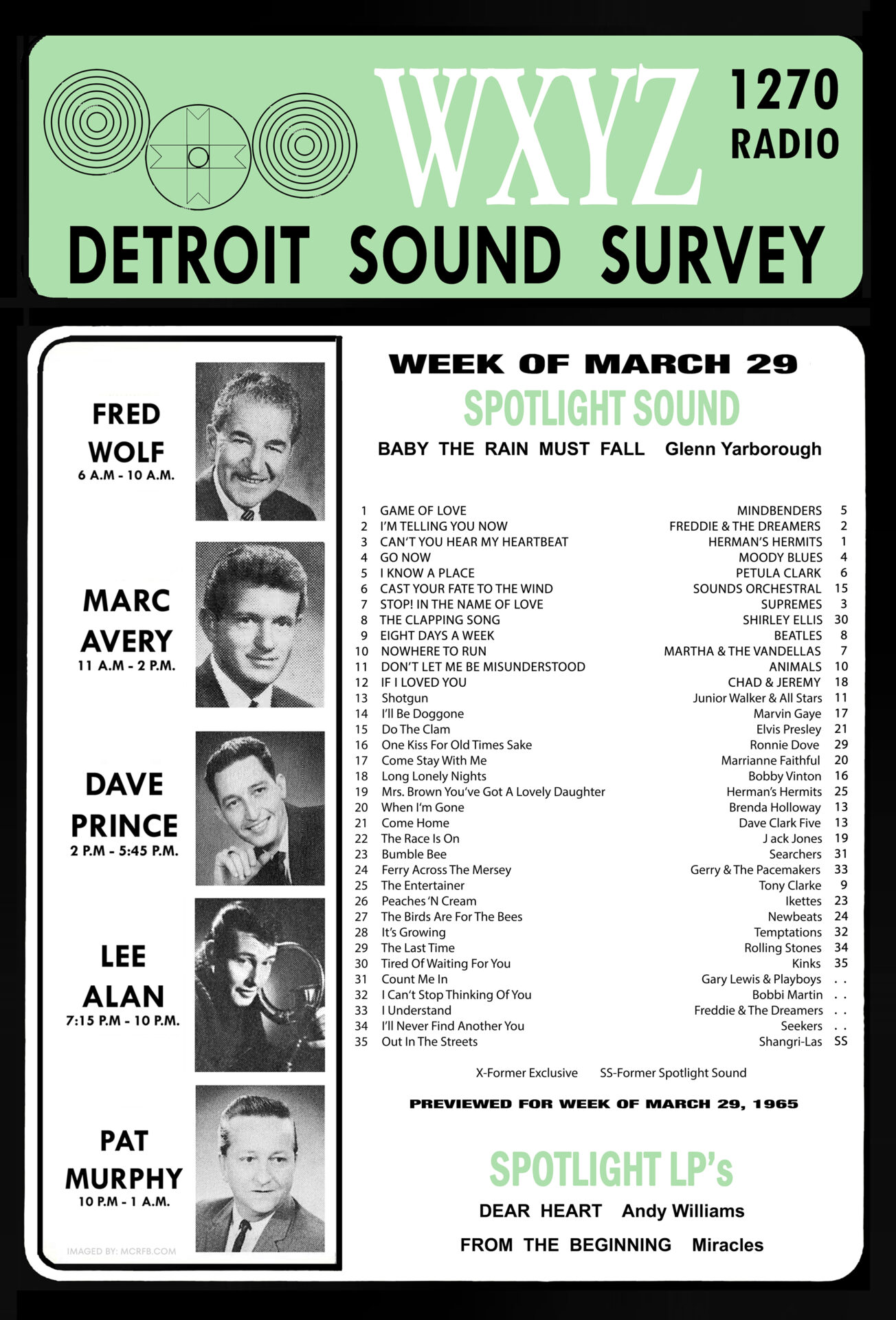
WXYZ RADIO 1270: THE DETROIT SOUND SURVEY! MARCH 29, 1965

______________________________

This list is selected each week by WXYZ Radio reports of records sales gathered from leading record outlets in the Detroit area and other sources available to WXYZ.

The above WXYZ 03/29/1965 chart survey was digitally restored complete in its entirety by Motor City Radio Flashbacks.

_______________

By mid-January 1965, the Detroit Sound Survey charts was no longer printed for the public in general. The WXYZ charts, as featured above, were instead published solely for Detroit record retailers, music outlets, one-stop jobbers, and distributors only.

These Radio 1270 top 40 charts was the largest of the WXYZ Detroit Sound Survey charts ever printed, having measured 17.5″ W x 22 L” inches in size. These charts were primarily used for weekly record rank based by popularity, position, retail sales, and were used for record retail rack displays as well.

For the very first time, Motor City Radio Flashbacks will be featuring a dozen or so — as chart dated — of these extremely rare WXYZ 1965 surveys throughout the year, 2024.
_______________

ON YOUR MOBILE DEVICE? Tap over WXYZ chart image. Open to second window. “Stretch” chart across your device screen to magnify for largest detailed view.

ON YOUR PC? Click on chart image 2x for largest detailed print view.

Loading

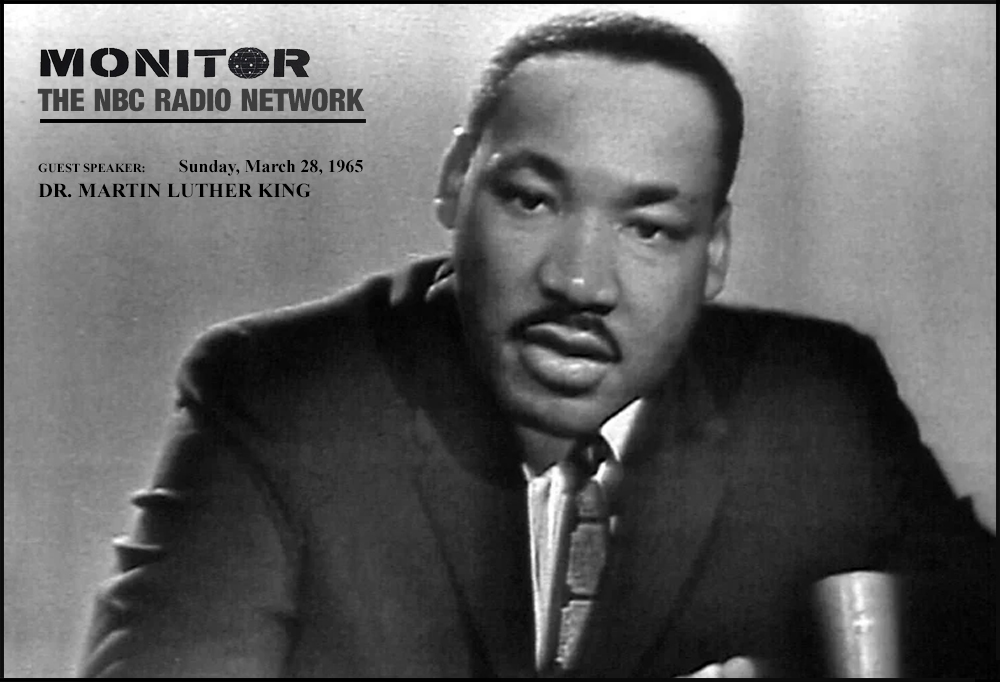
THE NBC RADIO NETWORK: MONITOR on WWJ RADIO 950, MARCH 28, 1965

Audio digitally restored by Motor City Radio Flashbacks

______________________________

Monitor was an American weekend radio program broadcast live and nationwide on the NBC Radio Network from June 12, 1955, until January 26, 1975. It began originally on Saturday morning at 8am and continued through the weekend until 12 midnight on Sunday. After the first few months, the full weekend broadcast was shortened when the midnight-to-dawn hours were dropped since few NBC stations carried it.

The program offered a magazine-of-the-air mix of news, sports, comedy, variety, music, celebrity interviews and other short segments (along with records, usually of popular middle-of-the-road songs, especially in its later years). Its length and eclectic format were radical departures from the traditional radio programming structure of 30 and 60 minute programs and represented an ambitious attempt to respond to the rise of television as America’s major home-entertainment medium.

The show was the brainchild of Sylvester (Pat) Weaver, whose career bridged classic radio and television’s infancy and who sought to keep radio alive in a television age. Believing that broadcasting could and should educate as well as entertain, Weaver fashioned a series to do both with some of the best-remembered and best-regarded names in broadcasting, entertainment, journalism, and literature taking part. Monitor and the Sunday-afternoon TV documentary series Wide Wide World were Weaver’s last two major contributions to NBC, as he left the network within a year of Monitor’s premiere.

When Monitor began on June 12, 1955, at 4pm, the first hour of the program was simulcast on NBC-TV. That initial June 12 broadcast lasted eight hours, from 4pm through 12 midnight. Following the Monitor beacon, Morgan Beatty was the first voice ever heard on Monitor. After an introduction by Pat Weaver, news headlines by Dave Garroway and a routine by Bob and Ray, Garroway cued Monitor’s opening music remote: live jazz by Howard Rumsey and the Lighthouse All-Stars at the Lighthouse Café in Hermosa Beach, California. It was the first of many jazz remotes in the weeks to come.

On the following Saturday, June 18, Monitor began broadcasting 40 consecutive hours each weekend, from 8am on Saturday to midnight on Sunday. Monitor aired from a mammoth NBC studio called Radio Central, created especially for the program, on the fifth floor of the RCA Building in midtown Manhattan (the same space which is now home to MSNBC). NBC unveiled Radio Central to the national television audience during a segment in the October 16, 1955 premiere of Wide Wide World, including a Monitor interview with Alfred Hitchcock (seen through glass in an adjacent studio and minus audio) and a Monitor newscast (with audio). Built at a cost of $150,000 the glass-enclosed studios of Radio Central were described by Pat Weaver as “a listening post of the world.”

Monitor Beacon

The enduring audio signature of the show was the “Monitor Beacon” — a mix of audio-manipulated telephone tones and the sound of an oscillator emitting the Morse code signal for the letter “M”, for “Monitor”. It was described by one source as “a tape loop made from a sequence of 1950s AT&T telephone line switching tones generated by analog oscillators”.

The Beacon introduced the show and was used in transitions, for example, to station breaks, accompanied by the tag line: “You’re on the Monitor beacon.”

The innovative approach of Monitor made it a profitable success for NBC Radio over many years, helping to sustain the network in an era when network radio was collapsing. Its strong start and high popularity led the show to air on Friday nights from 8pm to 10pm in 1957, followed by an expansion to weeknights in 1959, all in addition to its 32 weekend hours (reduced from 40 in late 1955).

By 1961, the weeknight Monitor was gone and the weekend schedule cut in half – from 32 to 16 hours each weekend. This was not quite as drastic a cut as it seems, as some programming that had been counted as part of Monitor’s 32 hours—such as Sunday morning religious broadcasts and the radio version of Meet the Press—continued to air on NBC outside of the Monitor schedule. This was further shortened in 1974 to only 12 live weekend hours (plus nine repeated hours).

Radio stations, especially in large markets, had increasingly adopted personality-driven formats featuring local disc jockeys and sought to establish a clear-cut musical or talk identity for themselves. Because of this, Monitor’s “something-for-everyone” programming often did not fit in with schedules and viewpoints of stations, and fewer affiliates carried the program in major markets. Due to this, many of the show’s sponsors also pulled away, requiring a shortening of the schedule to keep costs low.

About 125 stations still carried the program on its last day, with few in major markets. After 20 years of broadcasting, Monitor signed off after airing it’s last program on January 26, 1976.      Source: Monitor (Radio Program) Wikipedia

Monitor March 28, 1965

Addendum

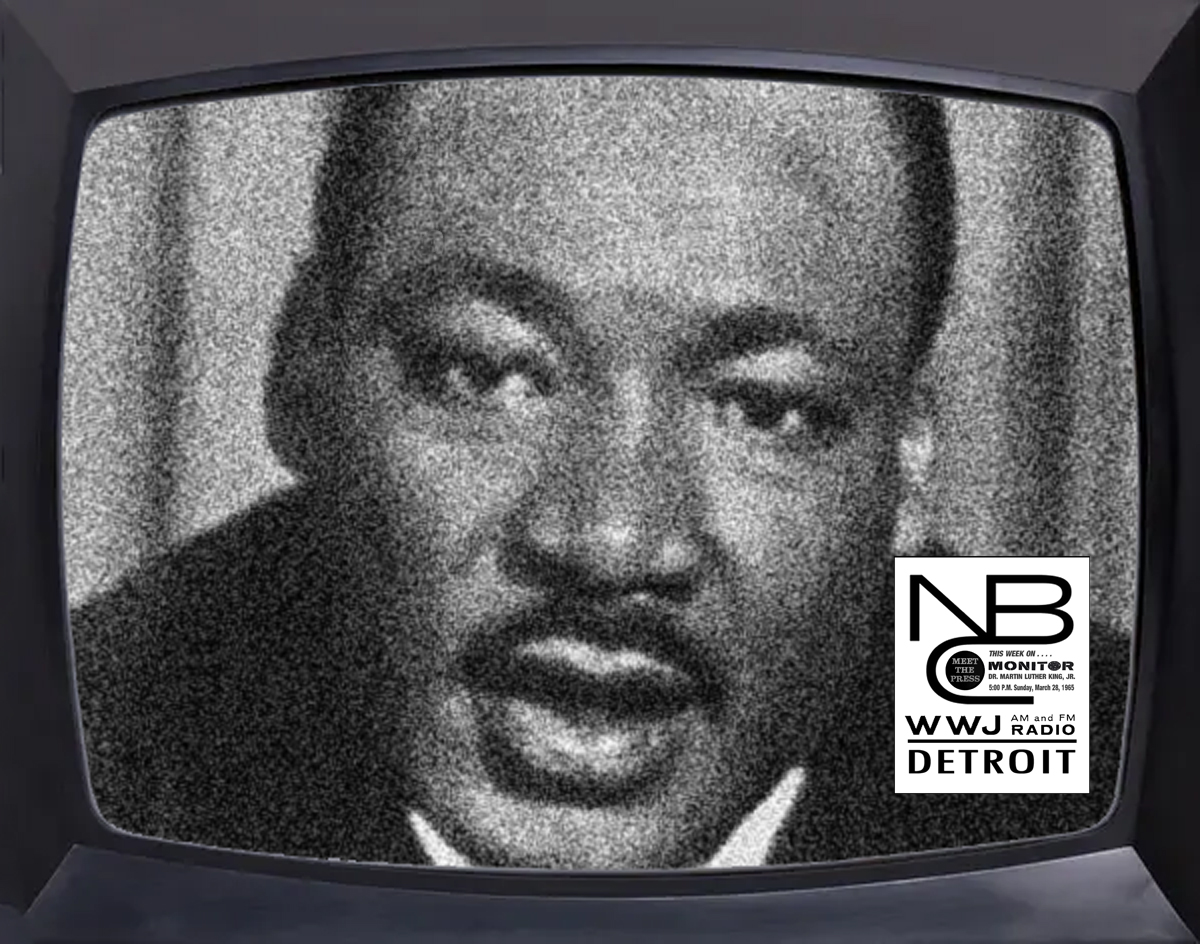
On Sunday, March 28, 1965, the presented NBC Monitor program aired on WWJ 950 (Detroit) at the top of the 5:00 p.m. hour, according to the Detroit Free Press radio guides, as dated, and published that year [Detroit Free Press Newspaper Archive, copyright 2024].

In this Monitor segment, the guest speaker was 1964 Nobel Prize winner and ’60s civil rights activist, Dr. Martin Luther King, Jr.

The program panelists and the voices you will hear are those of James K. Kilpatrick (The Richmond News Leader), Tom Wicker (The New York Times) John Chancellor (NBC News), and Lawrence J. Spivak (Producer; Meet the Press). Program was moderated by Ned Brooks.

The panelists queried Dr. King for answers and his views of the civil rights movement under his leadership.

Dr. King provided direct responses to inquiries and remarks, alongside those of other panelists. The discussion encompassed topics such as racial segregation in Southern states, the Supreme Court’s stance on racial justice and injustices, the administration of Governor George Wallace in Alabama, the historic march from Selma to Montgomery, and the tragic death of Viola Liuzzo in Alabama (originally from Detroit; for further details, refer to the newspaper insert).

Also addressed were Dr. King’s consistent appeals for “moral” and “non-violent” demonstrations, the organization of additional Southern economic boycotts, and the movement’s future prospects, with a focus on contemporary topical debates at the time.

Motor City Radio Flashbacks

_____________________________

This recording was made possible, and is the property (and courtesy) of the Past Daily website, from the incredible collection of it’s owner, Gordon Skene.

This featured audio recording, in its presented form, was at one time freely available and downloadable (as all their recordings were) from the Past Daily site, early on. This author obtained dozens of Past Daily historic recordings when they were available, many years ago. Motor City Radio Flashbacks has, and to his credit, featured several of Gordon Skene’s period recordings, such as we have presented here today, in the past. Founded in 2012, Past Daily still thrives on the internet today.

For support, and more on Past Daily, please click on the link in our menu column at the left of our site’s home page. Or, you may go, HERE.

______________________________

NOTE: Double-click over newspaper clipping for largest PC detailed view. Or tap, then stretch clipping across your mobile device screen for expanded read.

Loading

RECORD WORLD! THE 100 TOP POPs CHART: WEEK OF MARCH 25, 1967

RECORD WORLD became one of three weekly music trade magazines (Billboard; 1894, Cash Box; 1942, being the other two) when it began its publication in 1946 as Music Vendor. The MV title was changed to Record World, April 1964, and so remained under that banner until it ceased publication, April 1982.

The featured singles chart courtesy of Record World, as issued, for this week in March 1967.

_______________

The featured Record World chart were digitally re-imaged and restored by Motor City Radio Flashbacks

ON YOUR PC? You can read the above Record World 03/25/1967 chart ENLARGED. For a larger detailed view click above images 2x and open to second window. Click image anytime to return to NORMAL image size.

Click your server’s back button to return to MCRFB.COM home page.

ON YOUR MOBILE DEVICE? Tap over chart image. Open to second window. “Stretch” across your device screen to magnify for larger print view.

Loading

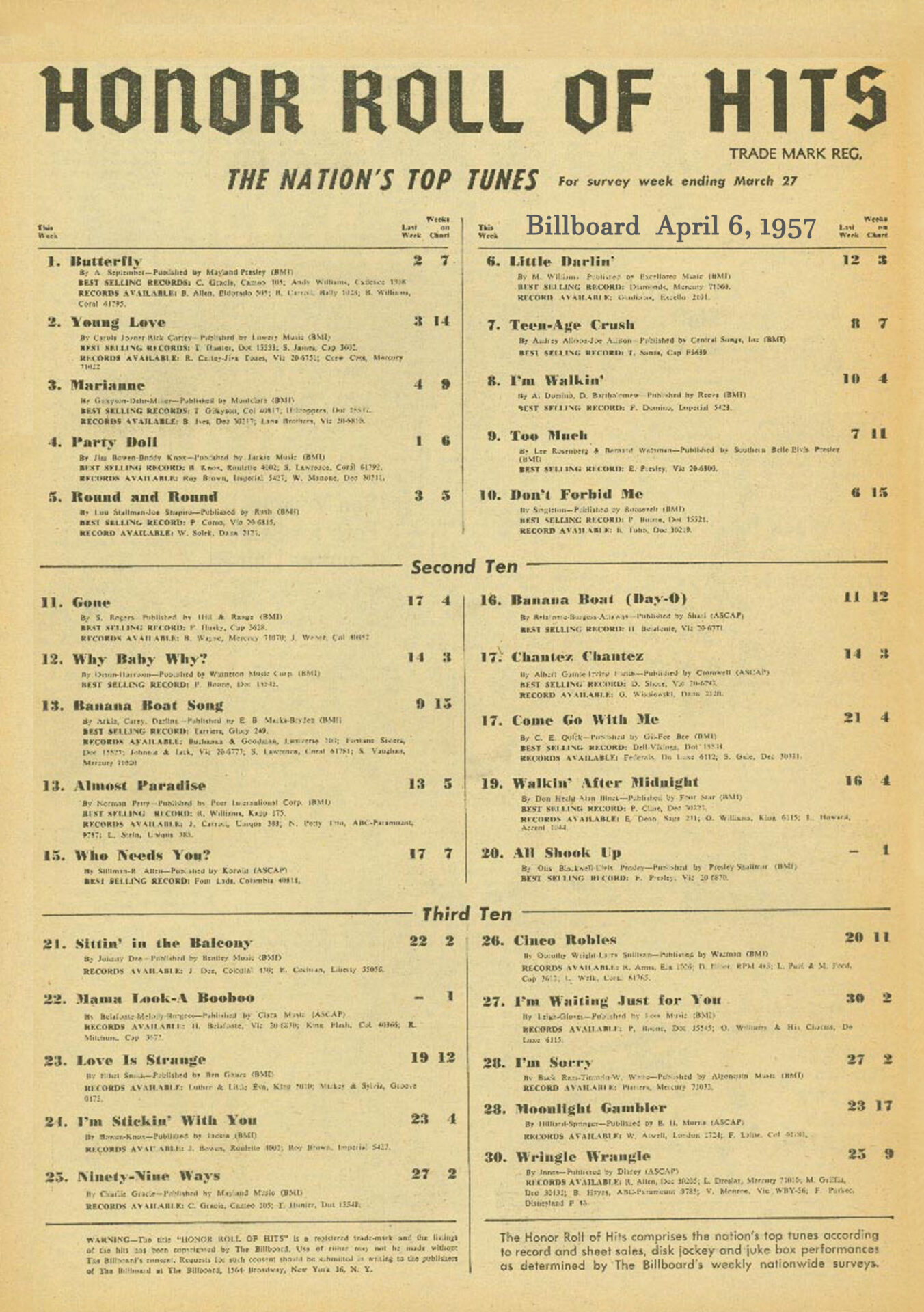
BILLBOARD HONOR ROLL of HITS! THE NATION’S TOP 30 TUNES: WEEK ENDING, MARCH 27, 1957

The Billboard Honor Roll of Hits for week-ending, March 27, 1957

_______________

The Honor Roll of Hits comprises the nation’s top tunes according to record sales and sheet sales, disk jockey and jukebox performances as determined by The Billboard’s weekly nationwide sales.

_______________

Audio digitally restored by Motor City Radio Flashbacks

The above Honor Roll Of Hits  chart was digitally restored by Motor City Radio Flashbacks

ON YOUR PC? You can view this entire Billboard 04/06/1957 chart ENLARGED. For a larger detailed view click above chart image 2x and open to second window.

Click image anytime to return to NORMAL image size.

ON YOUR MOBILE DEVICE? Tap over chart image. Open to second window. “Stretch”chart  across your device screen to magnify for larger print view.

Loading

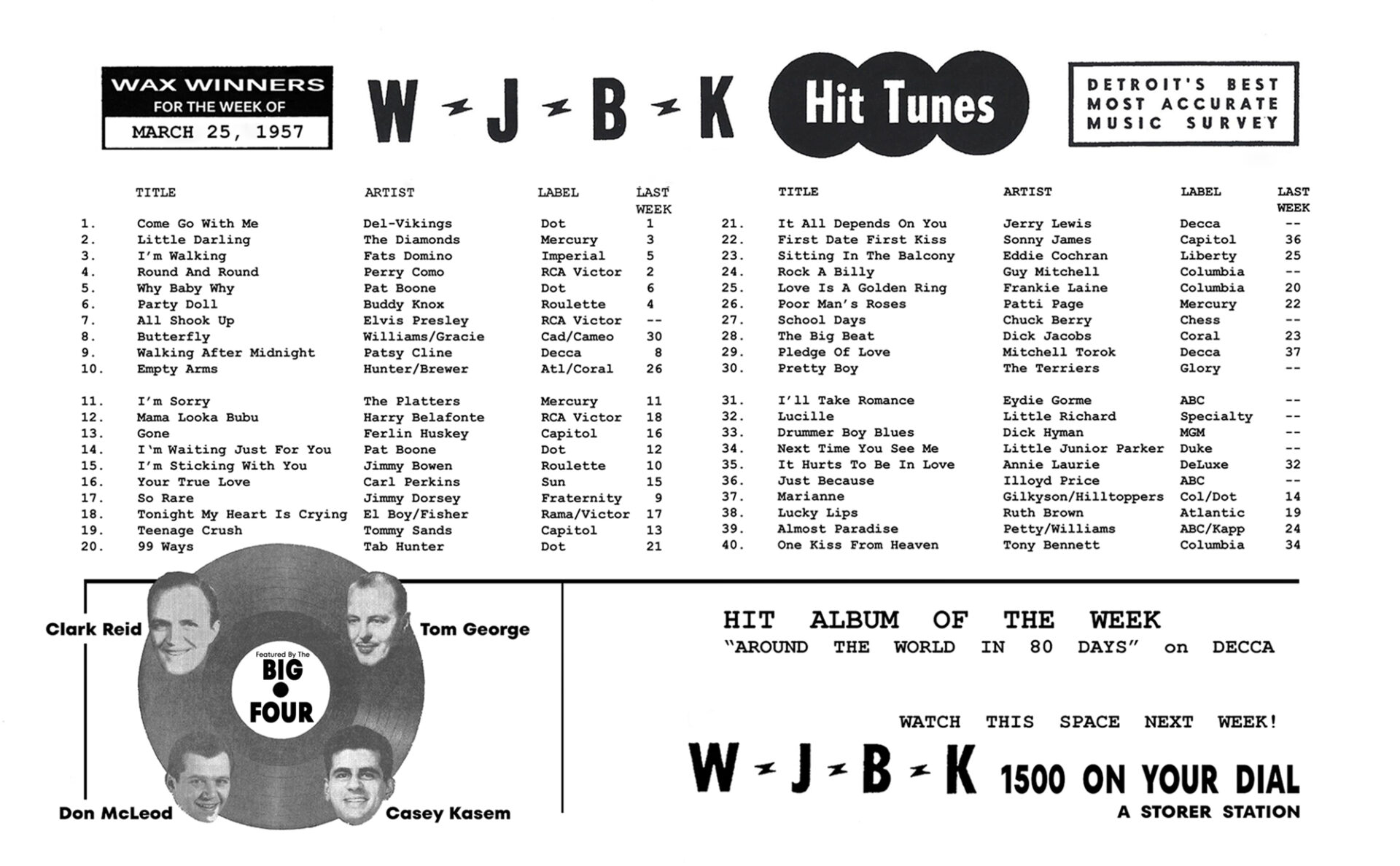
WJBK RADIO 1500: THE HIT TUNES INDEX! THIS WEEK, MARCH 25, 1957

The WJBK HIT TUNES INDEX hits was compiled, tabulated and produced by Radio 1500’s Bob Martin and Rosemary McGann.

This survey was tabulated overall by each record’s popularity and its appeal, sales, listener requests and record airplays based on the judgement of WJBK Radio. Previewed for the week of March 25, 1957.

This presented WJBK 03/25/1957 chart was digitally restored by Motor City Radio Flashbacks

ON YOUR PC? To fully appreciate this WJBK Music Survey for the week of March 25, 1957 chart feature click on image 2x and open to second window. Click image anytime to return to NORMAL image size.

Click your server’s back button to return to MCRFB home page.

ON YOUR MOBILE DEVICE? Tap on chart image. Open to second window. “Stretch” chart across your device screen to magnify for largest print view.

_______________

A sincere thank you, Mrs. Patti Griggs. This featured presentation would have not been possible without your generosity, dedication, and your continuous support.

Above WJBK music chart courtesy of Mrs. Patti Griggs and the George L. Griggs estate.

Loading

W4 106.7 FM COUNTRY! A LATE-1980s ‘JAM PRODUCTIONS’ JINGLES PACKAGE

Audio was digitally enhanced by Motor City Radio Flashbacks

Shamrock Broadcasting purchased W4 in July 1979. The station is most remembered today as one of the early radio jobs for Howard Stern, who was brought in from Hartford, Connecticut, to host mornings, beginning April 21, 1980. However, W4 was one of four Detroit stations with an AOR format, and faced with increasing competition and rapidly falling ratings, management decided to make a change.

With no advance notice, Shamrock changed the station’s format to country music on January 18, 1981. At first, the DJs, including Stern, were kept on to play country hits. The station reportedly planned to brand Howard Stern as “Hopalong Howie,” which he declined after two weeks, moving to WWDC-FM in Washington, D.C. In the film “Private Parts”, Stern announces his departure in the middle of a song, claiming he didn’t understand country music.

The move to country music paid off; the Detroit radio market, the nation’s fifth largest at the time, had no FM country music station. In addition, Detroit and its suburbs had a sizable percentage of the population whose families hailed from the Southern United States and grew up with the genre. W4 Country’s first years coincided with the rise in popularity of country music, even outside the South. At the time of the country format’s launch, the immediate Detroit area’s only country music station was on AM, WCXI at 1130 kHz. WWWW became the first FM country station in Detroit since WCAR-FM’s and CKLW-FM’s brief tries at the format in the mid-1970s. As a result, WCXI’s ratings fell. By the early 1990s, AM 1130 was being used as a simulcast for W4.

“W4 Country” lasted almost two decades and did reasonably well in the ratings, under the leadership of programmer Barry Mardit, who joined the station in late 1981. The station posted a #1 finish in the Fall 1992 Detroit Arbitron radio ratings with an 8.7 share. The following year, the station gained a strong competitor in WYCD, causing WWWW’s ratings to decline. Recording artist Holly Dunn served as morning co-host on W4 Country during the late 1990s. Declining ratings and revenue led owners AM-FM (which became part of Clear Channel Communications in August 2000) to drop the country format at 6 p.m. on September 1, 1999. The final song played on “W4 Country” was “The Dance” by Garth Brooks, followed by “The Star-Spangled Banner.”

_______________

Source and information, credit: WWWW Wikipedia

The featured WWWW Jingle package is property of JAM, Incorporated. The JAMS logo and brand is licensed and marketed by JAM Productions, Dallas.

Loading

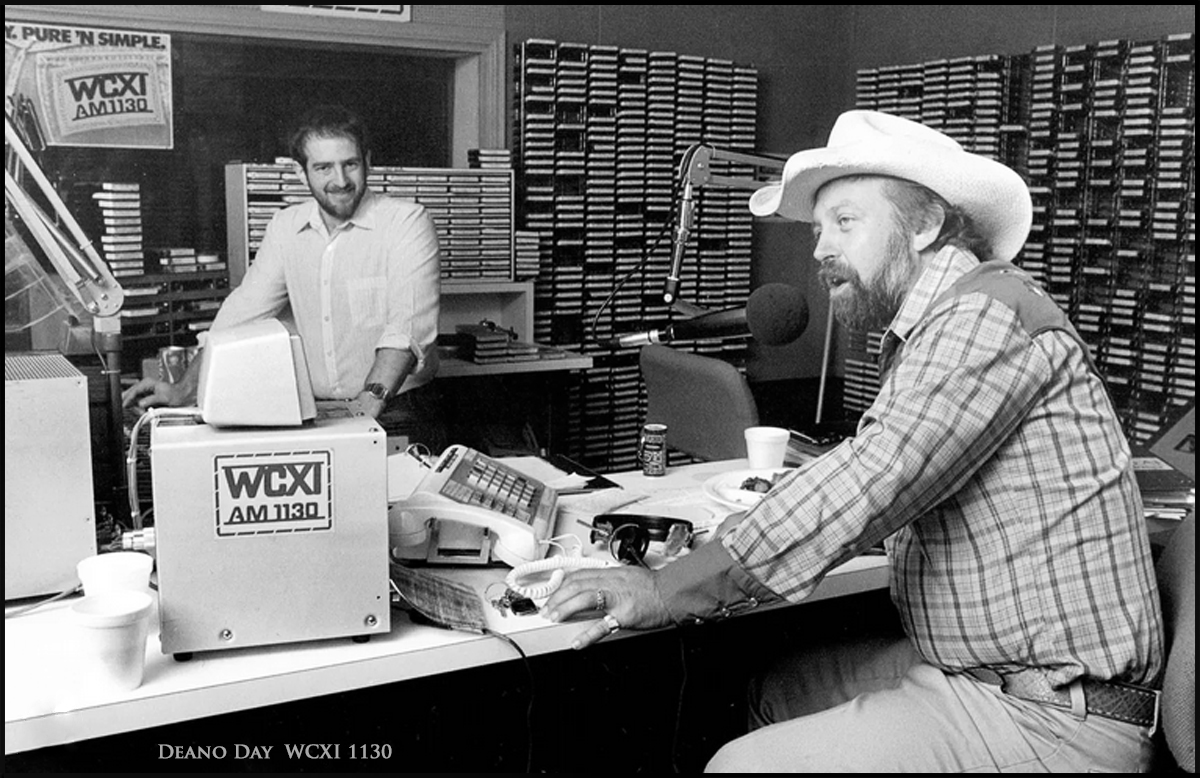
NEWLY RESTORED! WCXI-AM 1130 BACK ON THE RADIO: DEANO DAY, MAY 7, 1979

This WCXI Deano Day audio file, in it’s archived, original and unrestored form was selected for today’s special aircheck “restoration” presentation.

_______________

Newly restored! This selected audio recording was digitally remastered by Motor City Radio Flashbacks.

Loading

WEXL RADIO 1340! JANUARY 26, 1965 [The Detroit Free Press] DETROIT RADIO BACK-PAGE AD

THE DETROIT FREE PRESS Tuesday, January 26, 1965

_______________

This article/advertisement courtesy freep.com newspaper archive. Copyright 2024. Newspapers.com

Printed in black and white, the featured Detroit Free Press ad was digitally re-imaged, colorized, and was entirely restored by Motor City Radio Flashbacks.

Missed any of our previous ‘Detroit Radio Back-Pages‘ features? GO HERE

A special thank you to senior MCRFB consultant Greg Innis, of Livonia, MI., for contributing the Newspapers.com archives (Detroit radio related) articles, ads, and images we have provide for this site since 2016.

Thank you, Greg Innis, for making these historic Detroit radio features possible. ?

Loading