WQTE ‘PAMS’ Jingle Pak on MOTOR CITY RADIO FLASHBACKS
WQTE-AM * Series 14 *1960-1961
PAMS #14 “DRAMATIC SIGNATURES” SERIES
—1960—
A NOTE ON THESE WQTE JINGLES
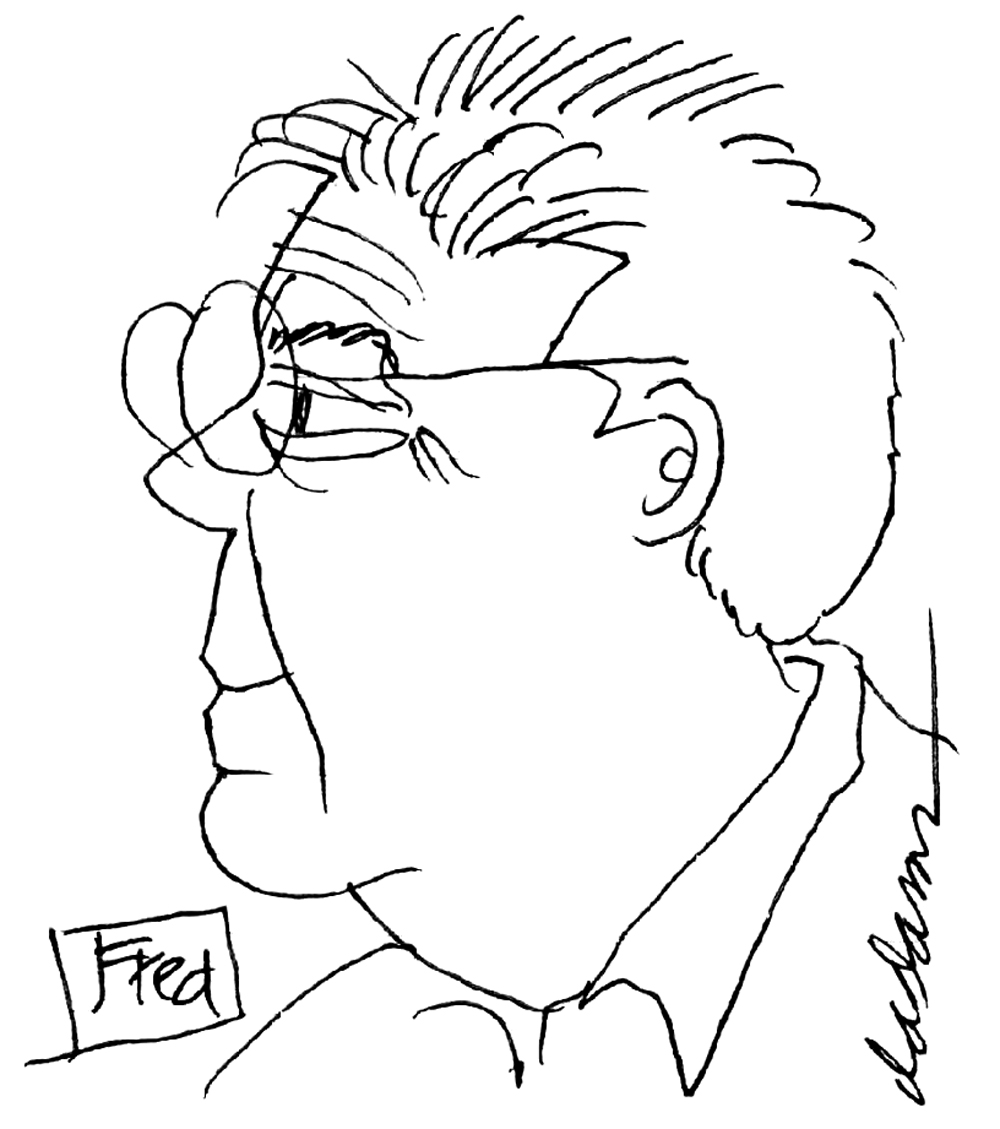
A Fred Vobbe profile sketch (featured on his Facebook page)
While Motor City Radio Flashbacks had this WQTE package (unmarked) in the collection for years now, we didn’t know with any degree of certainly what year and what series this jingles package was initially numbered when it was created by PAMS, 60 years ago.
A special THANK YOU to website contributor Frederick Vobbe for providing the proper numbered PAMS series originally tagged with this classic WQTE jingle package.
Frederick R. Vobbe was the former engineer at Greater Media WHNE/WHND/WMJC in Birmingham, MI., late-70s through the 1980s.
Today he resides in Lima, Ohio, where he is chief engineer for radio and television in that market.
The featured WQTE jingle package has been digitally enhanced in sound by Motor City Radio Flashback
NEW!BOB HEYDEN WHND aircheck date SUNDAY, MARCH 17, 1991
*****
— WHNE FM ‘HONEYRADIO’ WHND AM —
In August 1973, Detroit oldies station WHFI 94.7 FM became the former when the station changed its call letters to WHNE. WHNE, better known as ‘Honeyradio’ since its beginning, promoted and increased their own “All-Oldies” brand (1955-1970) on “FM 95” under the direction of FM automation programmers Bill Drake and Lester Chenault, owners of Drake/Chenault Enterprises.
By April 1976, Greater Media, owners of WHNE 95 and WQTE 560, dropped the oldies format on the FM side and changed formats to adult contemporary, playing soft-rock favorites on the new WMJC “Magic 95”.
WQTE (at time playing “Beautiful Music”)became the new WHND in April 1976, retaining the FM automated ‘All-Oldies’ banner on AM after having made its mark as “Honeyradio” on 94.7 FM. Four years later, the automation was dropped on WHND for live in-studio disk Jockeys, latter-1980.
By 1991, WHND was billed to be the oldest, all oldies radio station in the nation still on the dial. The station notched its place on 560 AM having played the biggest hits from the rock ‘n’ roll era for over 18 incredible years in the Motor City.
WHND’s amazing run came to an end on November 25, 1994, when, just before sundown, Fred “Boogie” Brian closed out ‘Honeyradio’ with a farewell and final song, “I’ll Remember You,” by Elvis Presley.
The above featured aircheck was audio enhanced by Motor City Radio Flashbacks
NEW!J. P. McCARTHY WJR aircheck date: unknown FEBRUARY 1991
__________________
BYRON MacGREGOR
___________________
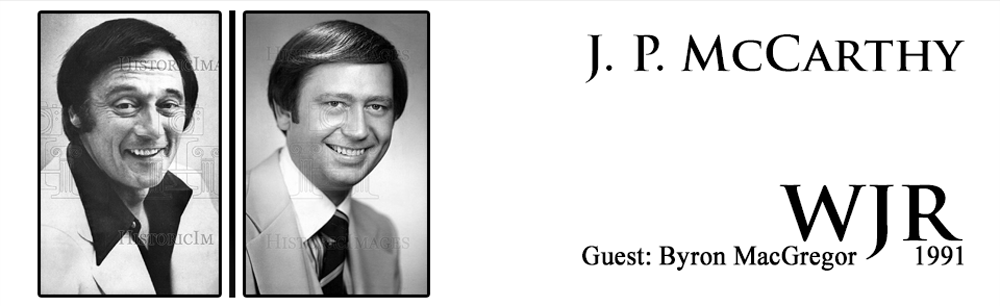
In this brief interview, J. P. speaks with Byron about the current 1991 resurgence of his 1974 patriotic hit, “The Americans”.
NOTE: This WJR interview was conducted some days before the Gulf War came to a rapid close, ending this country’sdirect U.S. military involvement in the liberation of Kuwait. A military cease fire was declared by President George Herbert Walker Bush, formally ending the conflict on February 28, 1991.
Four years after this 1991 interview – 25 years ago – J. P. McCarthy passed away on August 16. Eight months and two weeks after we lost Byron MacGregor on January 3, 1995.
How Capitol Records Met Production Challenges For More Beatles Records to Suit Band’s Phenomenal Rise and Demand
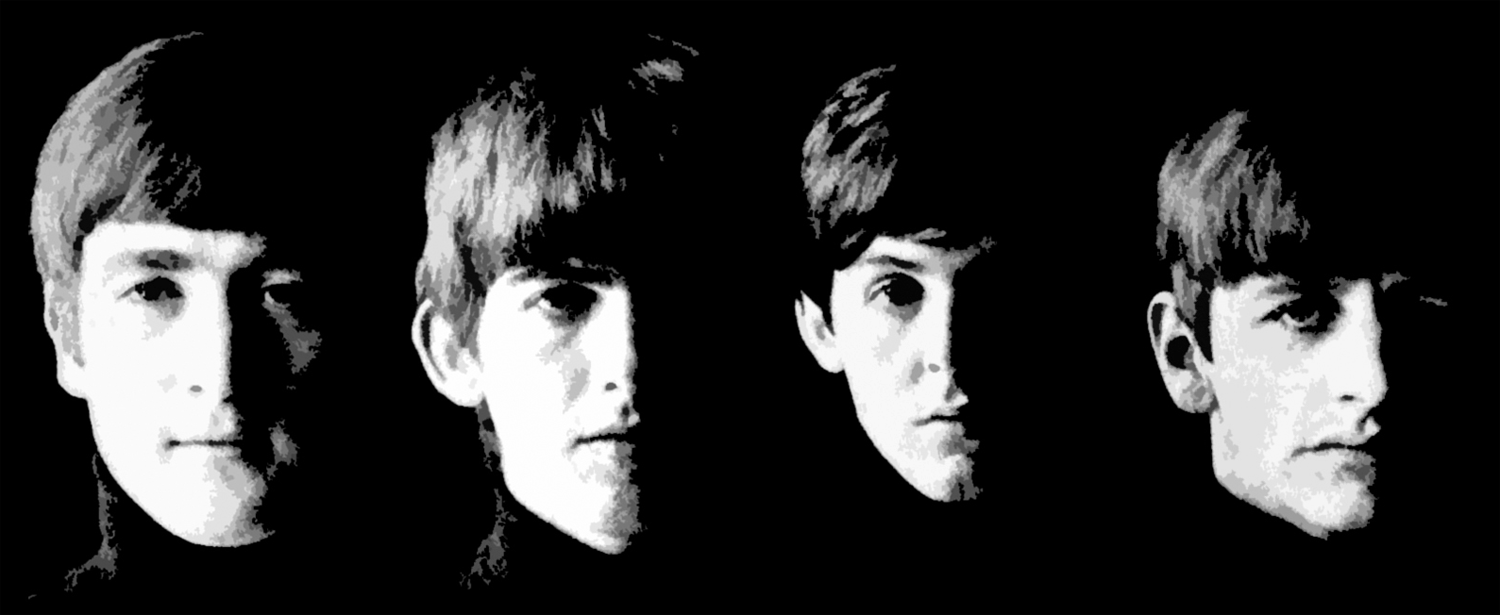
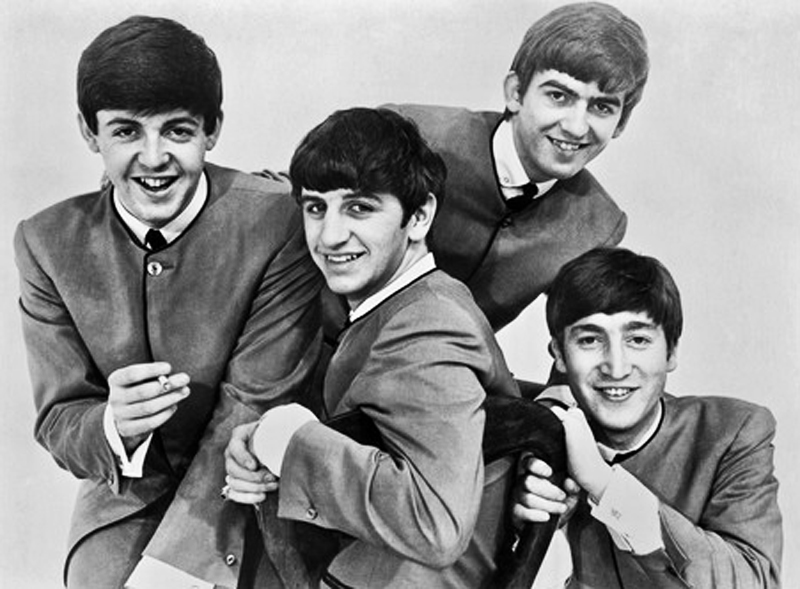
One thing is certain – the record industry will never be the same as it was before The Beatles, and neither will Capitol Records.
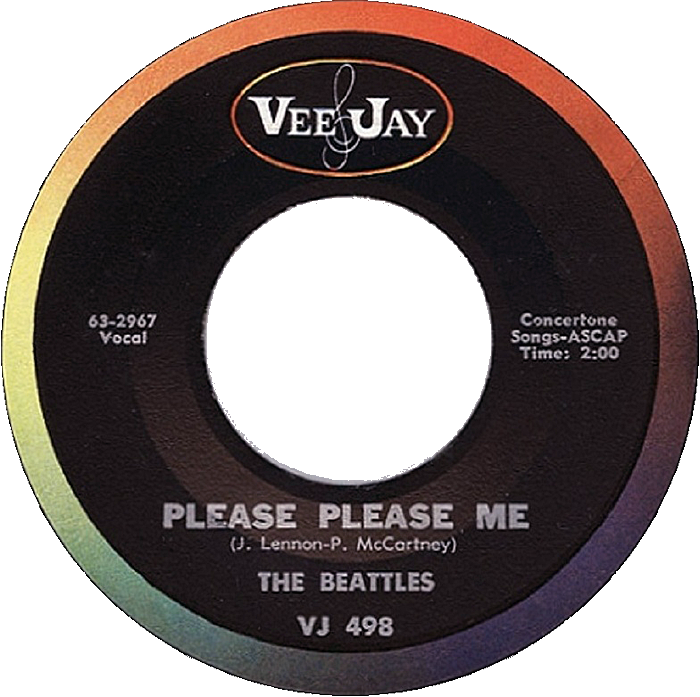
The incredible success of The Beatles on record (3.5 million singles and 3.5 million LP’s on Capitolalone, and million-plus sellers on both Vee Jay and Swan), and the attendant success of the lads on TV, in personal appearances and in media coverage, indicates that records are the most dynamic exposure medium available for young artists. Records far outdistance TV and movies, live appearances or anything else in creating a national image in a hurry.
And it also indicates that the record industry, working with its partner, radio, can expect at any time that one of its artists overnight can become an overwhelming national favorite, to an extent that would have surprised even the most optimistic record manufacturer less than two years ago.
IN A YEAR AND A HALF, the record industry has seen three massive breakouts of records featuring new artists, who – until their records were exposed were relatively unknown. In the fall of 1962 the album of folk song parodies by Allan Sherman on Warner Bros. sold more than a million in little over two months. In November and December of 1962 and January of 1963, the album by Vaughn Meader on Cadence, “The First Family,” sold four million LP’s and broke every existing LP sales record. And less than a year later, The Beatles did it again.
There have been, of course, massive sellers before Sherman, Meader and The Beatles. Elvis Presley is the outstanding example on the pop side. Johnnie Ray did it with his smash hit; “Cry.” And there have been a number of show albums or sound tracks, “My Fair Lady,” “South Pacific,” “The Sound Of Music,” “West Side Story,” which have racked up sales in the millions. But these have occurred sporadically; the demand has not been concentrated in such a short time span as with the Sherman, Meader and Beatles releases.
Record companies are now learning to cope with the type of massive demand for records exemplified by these three big selling artists. Warner Bros. fumbled a bit at first in getting the LP’s and the jackets available at the same time when the Sherman set broke for them in the fall of 1962. Cadence did a masterful job in getting its product to market after only a few days of being overwhelmed by what it had wrought with “The First Family.”
Neither Warner Bros. nor Cadence owns its own pressing facilities. Capitol Records does. Its plants at Scranton, Pa., and Hollywood are among the largest in capacity in the U.S. Being able to turn out its own product was a tremendous advantage to Capitol when The Beatles got hot. But Capitol faced other production problems that did not affect either Warner Bros. or Cadence.
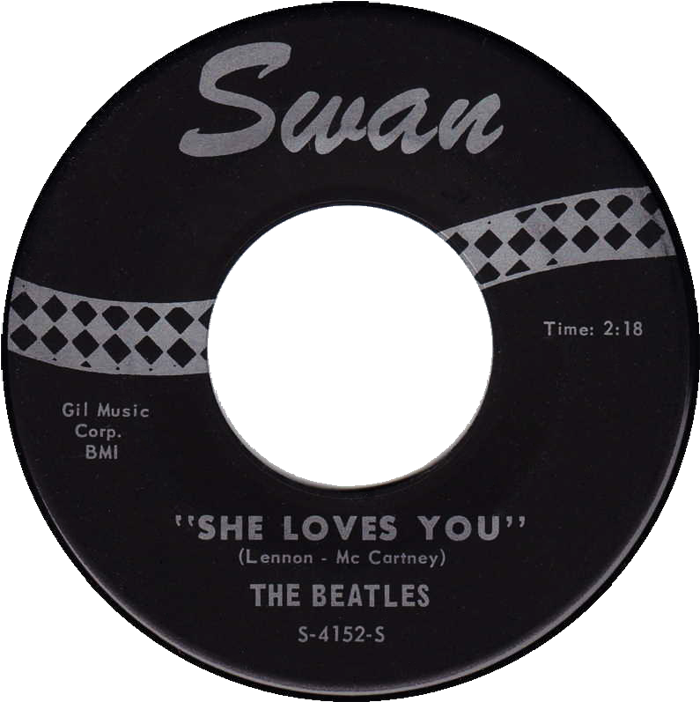
NO ONE AT CAPITOL believed the firm had latched on to an all-time seller when Capitol a. & r. chief VoyleGilmore made a deal with Beatles’ manager Brian Epstein in November last year for future Beatles’ product. Two previous Beatles’ releases had died in the U.S., one on Vee Jay and one on Swan. (Obviously, these records were not really dead, only sleeping.) But EMI executive Leonard Wood had told Gilmore and Capitol foreign boss Lloyd Dunn about the Beatles’ continuing success in England, and early stories about the Beatles (New York Times, Variety, Newsweek) had alerted other Capitol brass.
On word from Capitol president Alan Livingston, eastern operations chief, Brown Meggs, sent out first announcements to the trade. (Meggs, his secretary, Stacy Caraviotis, and West Coast-based publicity chief Fred Martin, were to bear the brunt of wearying public relations during the whole Beatles explosion.)
Immediately after the first press releases, many Capitol executives began to smell a hit. Calls began to come from dealers. There were other calls from press representatives, magazineeditors, and newspaper free lance writers, TV bookers – all waiting on the Beatles. And disk jockeys wanted to know when the records would be ready.
At this time the first Beatles record release was scheduled for February, when the lads were set to appear on the Ed Sullivan TV show. Capitol decided to move the release date up, and set it for early January.
But in December Ed Sullivan began to plug a Beatles appearance on a February show, and Jack Paar, who enjoys tangling with Sullivan, let his audience know that he would beat Sullivan by showing a TV film of The Beatles. This accelerated the excitement at Capitol and the firm again moved back the release date, this time to late December.
WITH A COMPANY the size of Capitol, it is not easy to play fast and loose with release dates. Capitol was already hot last December, with strong selling singles by The Beach Boys, Al Martino, Nat Cole and other acts, and the firm also had a number of hot LP’s riding. But somehow, in spite of Christmas (no shifts worked at the pressing plant Christmas eve or Christmas day), the firm had 1,342 Beatles singles in its Capitol distributing branches on December 26. These were immediately sent out to jockeys.
All over the country jockeys appeared to be waiting for The Beatles new record. The teen-age grapevine, which can smell a big hit from as far away as Japan, or as near as England, knew all about The Beatles, wanted the Beatles, and were calling local deejays for Beatles action. All over the country, from December 26 on, The Beatles got radio action-on stations in big cities, small cities and everywhere else.
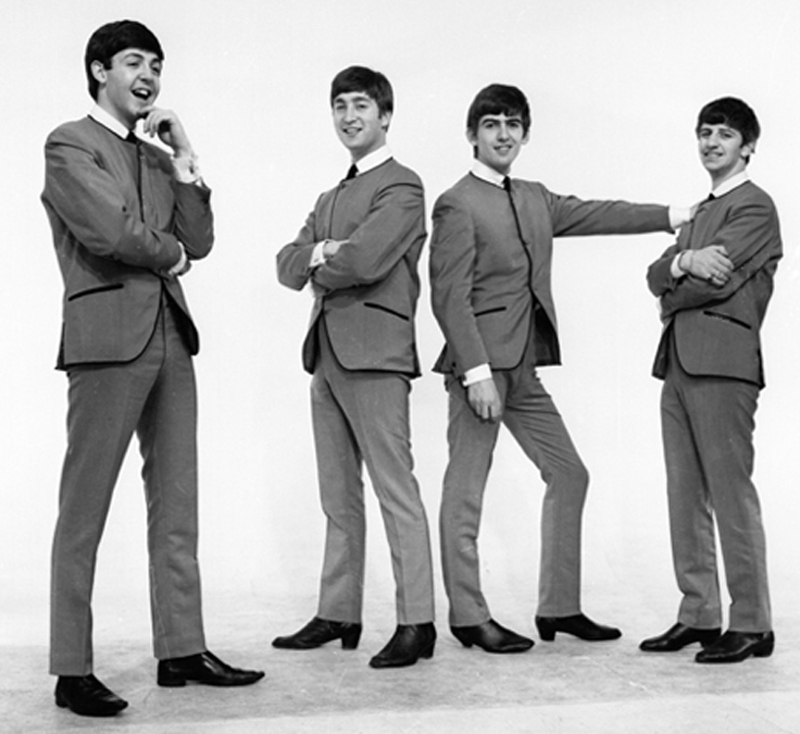
Before the record hit the stands, Capitol publicity had been busy. Bios of George Harrison, Paul McCartney, John Lennon and Ringo Starr were in the works. There was an overall story of the Beatlemania craze. A four-page newspaper, called The National Record News, “Special Beatles Issue” was being printed. (This later became a collector’s item.) And pictures in many poses hit editors’ desks. What seemed to be adequate amounts of each of these were ordered. (They turned out to be underestimated.) Capitol was embarked on the biggest promotion campaign in its history.
Within one week from the time the record was released (December 26), Capitol had orders for 200,000 Beatles records. (Most of these orders came from New York.) The plants in Scranton and Hollywood moved to catch up. During the week from December 30 to January 6 (in spite of the New Year’s holiday when the plants were closed), the firm pressed 134,225 Beatles’ singles. The next week the plants turned out 233,250 singles, and the week of January 13-17, the plants pressed 535,482 singles. And singles were still being back -ordered. (At this time New York area had used 262,381 singles.)
THE DEMAND for records became so intense, that the following week, Capitol ordered 300,000 records from RCA Victor’s New Jersey Rockaway pressing plant. And that same week Capitol issued the album called “Meet The Beatles” with 250,000 LP’s ready at date of issuance. These were soon gone into the maze of Beatlemania.
While the demand for records was outstripping production, Capitol continued to press records by other artists, who, in spite of The Beatles, were also selling. It has been a practice at the Capitol plants that no matter what the demand might be for one artist, it would also continue to press some other product, so that it would not get caught with only one artist on the market. During the period January 1 to February 28, Capitol pressed, in its own plants, about 1,250,000 records by such artists as The Beach Boys, Jody Miller, Al Martino, Ferlin Huskey, Wayne Newton, Bobby Darin, Nat Cole, Donna Lynn, and the Dovells.
Demand was also outstripping production for press matter. More than 25,000 bios of The Beatles were requested by jockeys, reporters and editors; more than 15,000 photos were requested. And one million copies of the four-page newspaper were offered before the demand was exhausted!
ON FEBRUARY 14, after Capitol plants had pressed about 1.7 million singles and almost one million albums, it began to farm out some Beatles work. Eight plants started to press Beatles’ singles and LP’s, and of this writing are still pressing, along with Capitol plants. It was February 28 before Capitol reached the point where it had enough merchandise on hand to fill back orders for the single.
Capitol was lucky with its single in one regard. On a sale of more than 3.5 million it gave away only 200,000 records. Though there was a 300 free deal for every 1000 bought when it was first issued, the demand for the record was so strong that Capitol Records Distributing Corp. singles sales chief Vito Samela was able to cut off the deal as of January 7. Samela and distributing promo head Manny Kellem had both been up to their ears in work in the frantic days.
The firm had a discount arrangement for the album. There was a 15 per cent deal on the LP from the start, and it was still on the first week of March, at which time the label had sold more than 3,000,000 “Meet The Beatles” LP’s. Capitol Records, like Victor with its first Presley release, has now been through its bath of fire. A new Capitol single by The Beatles was released Monday, March 16. One million copies of the record were available at the Capitol branches the day it was issued. As Samela told Music Business: “We will be able to keep up with the demand this time.”
ONE THING IS CERTAIN, the record industry will never be the same as it was before The Beatles, and neither will Capitol Records. END
_______________
Source and information: Music Business; March 21, 1964
CAPITOL RECORDS ad promoting a “brand-new” Beatles single. Billboard, March 1964
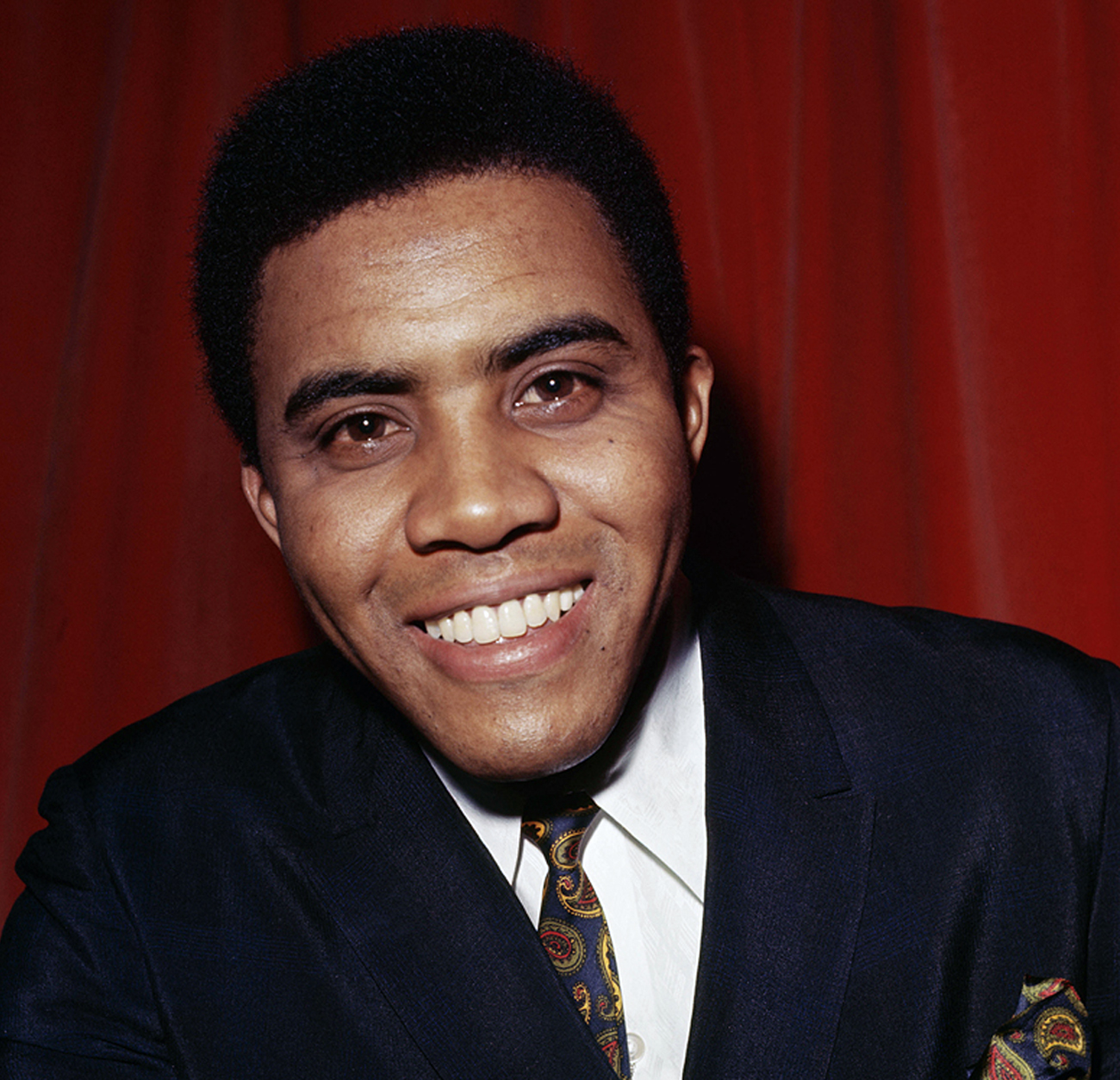
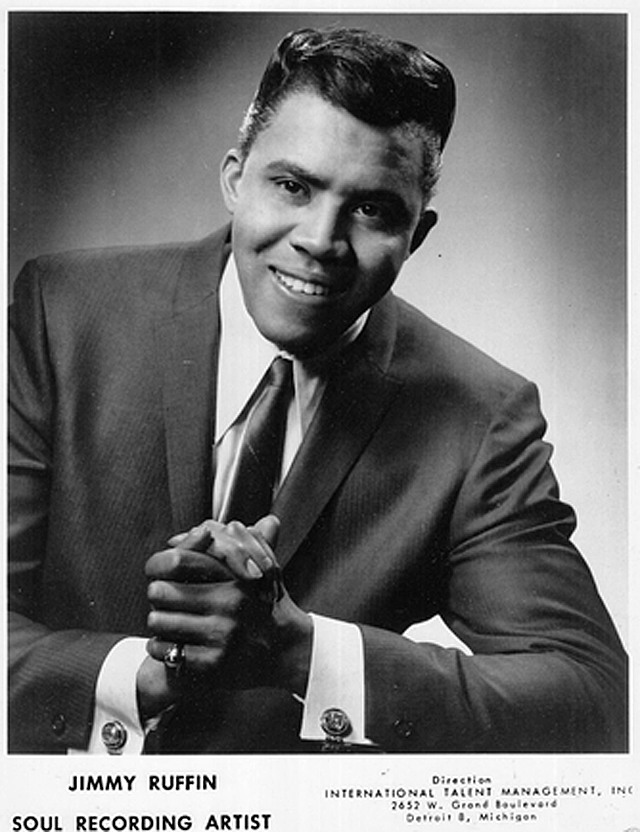
Jimmy Lee Ruffin(May 7, 1936 – November 17, 2014) was an American soul singer, and elder brother of David Ruffin of the Temptations. He had several hit records between the 1960s and 1980s, the most successful being the Top 10 hits “What Becomes of the Brokenhearted” and “Hold On (To My Love)”.
JIMMY RUFFIN 1965
In 1961, Jimmy became a singer as part of the Motown stable, mostly on sessions but also recording singles for its subsidiary Miracle label, but was then drafted for national service. After leaving the Army in 1964, he returned to Motown, where he was offered the opportunity to join the Temptations to replace Elbridge Bryant. However, after hearing his brother David, they hired him for the job insteadso Jimmy decided to resume his solo career. Ruffin recorded for Motown’s subsidiary Soul label, but with little success.
In 1966, he heard a song about unrequited love written for The Spinners, and persuaded the writers that he should record it himself. His recording of “What Becomes Of The Brokenhearted” became a major success. The song reached #7 on the Billboard Hot 100 and #6 on the R&B Chart. It also initially reached #8 in the UK singles chart, rising to #4 when it was reissued in the UK in 1974.
“What Becomes of the Brokenhearted” remains Ruffin’s best-known song. It was the lead single from his debut album Jimmy Ruffin Sings Top Ten (released as The Jimmy Ruffin Way in the UK), which was released on the Motown’s Soul subsidiary label in 1967. Follow-up singles in America were successful, with “I’ve Passed This Way Before” and “Gonna Give Her All The Love I’ve Got” in late 1966 and early 1967.
Ruffin’s second album, Ruff ‘n’ Ready, was released in 1969. It contained the song “Don’t You Miss Me a Little Bit Baby”, which made the lower parts of the Billboard Hot 100 (#68) and was a Top 30 hit on the R&B Charts, peaking at #27. As a solo artist, it would prove to be Ruffin’s last significant chart appearance in America for many years, and his very last significant charting record for Motown in the US. The song was also released as the B-side to “What Becomes of the Brokenhearted” when it was reissued in 1974.
Released August 19, “Don’t You Miss Me A Little Bit Baby” peaked at #27 (charted 6 total weeks R&B overall) on the Billboard R&B chart in 1967. B-side: “I Want Her Love”