CKLW BIG 8 JINGLE HEARD! BILL DRAKE PRODUCTIONS


CKLW ‘Bill Drake’ Jingles on MOTOR CITY RADIO FLASHBACKS

 CKLW * Drake Production Beds (5) * DRAKE/CHENAULT PRODUCTIONS


DRAKE-CHENAULT PRODUCTIONS; FRESNO, CA


*****

These short, 5 classic CKLW Bill Drake Production pieces was conceived, created and was produced by Drake/Chenault productions for the RKO Radio Network and CKLW (RKO) in 1967.

(Note: The last two sound beds served as ‘openers’ for the CKLW 20/20 news segments).


Loading

HARWELL. THE VOICE OF SUMMER’S PAST REMEMBERED


WELCOME TO TIGERTOWN * ERNIE HARWELL’S AUDIO SCRAPBOOK


‘WELCOME TO TIGERTOWN’


___

Besides the voice of Ernie Harwell, the various narratives you will hear throughout the entire audio book is by Raleigh, N.C. sports broadcaster Gordon Miller. Occasional questions you will also hear is by veteran Duke University sports broadcaster Bob Harris.


___


Ernie Harwell


Ten years ago, Ernie Harwell passed away on May 4, 2010. He was known as “the voice of the Detroit Tigers” for over 4 decades. He called his last Tiger game in Toronto, on September 29, 2002. In 1981, Harwell was awarded baseball’s most prestigious Ford C. Frick Award.

He became only the fifth baseball broadcaster enshrined into the Baseball Hall of Fame.

The Voice of Summer Remembered

(CD audio set availability, link: Ernie Harwell’s Audio Scrapbook 2009


The Detroit Free Press April 19, 1960


* A MCRFB VIEWING TIP *


ON YOUR PC? You can read this entire newspaper article — the fine print — ENLARGED. For a larger detailed view click above image 2x and open to second window. Click image anytime to return to NORMAL image size.

Click your server’s back button to return to MCRFB.COM home page.


ON YOUR MOBILE DEVICE? Tap on newsprint image. Open to second window. “Stretch” image across your device screen to magnify for largest print view.


The above featured newspaper article was ‘clipped,’ saved, and was digitally imaged from the credited source by Motor City Radio Flashbacks.


Loading

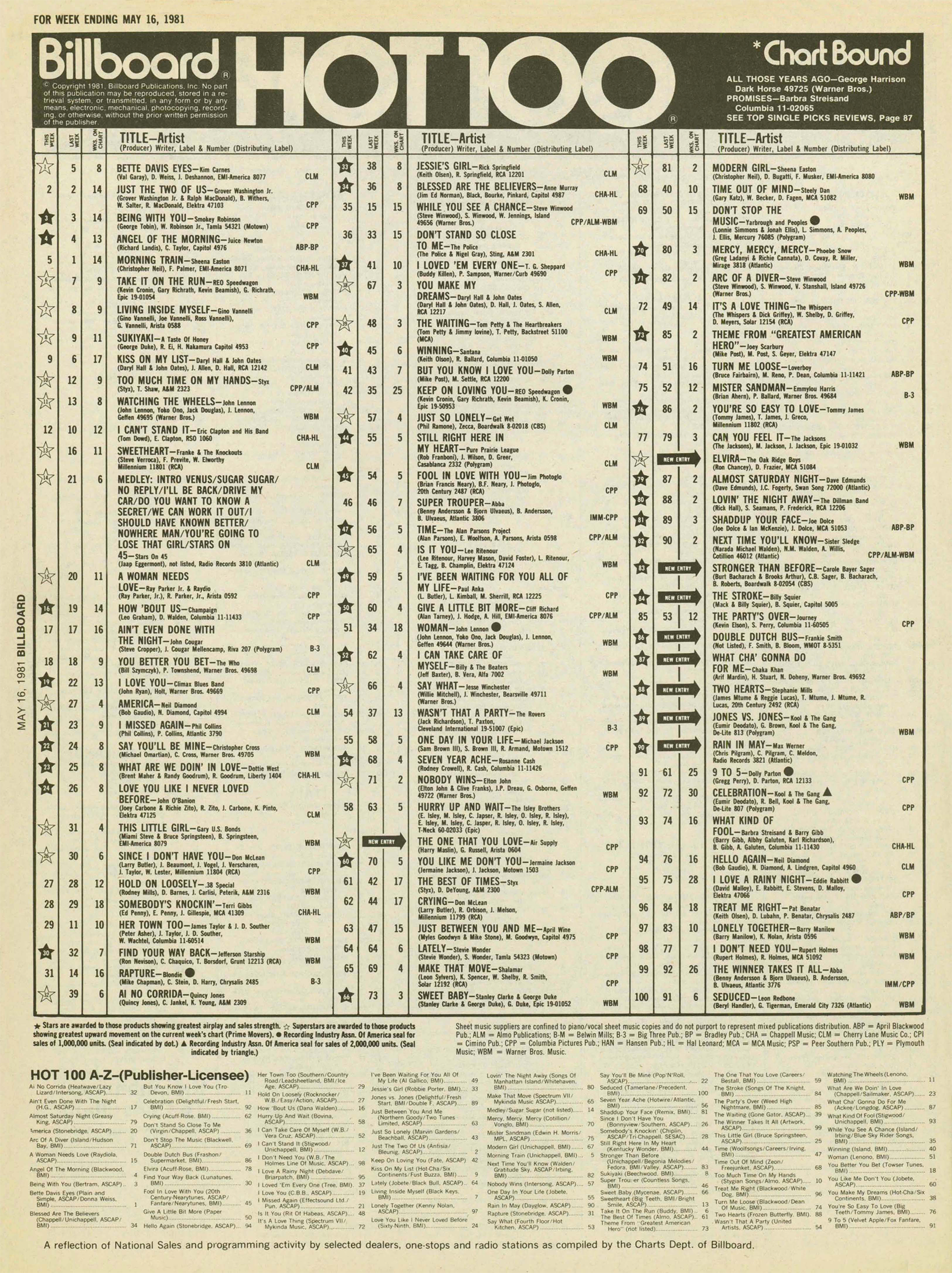
THIS WEEK IN AMERICA! BILLBOARD HOT 100: 05/16/81

BILLBOARD HOT 100 May 16, 1981


BILLBOARD HOT 100 TABULATED BY RECORDS RETAIL SALES AND RADIO AIRPLAY

BILLBOARD HOT 100 MAY 10-16, 1981


** A MCRFB VIEWING TIP **

ON YOUR PC?To fully appreciate this Billboard Hot 100 May 16, 1981 chart feature click on image 2x and open to second window. Click image anytime to return to NORMAL image size.

Click your server’s back button to return to MCRFB home page.

ON YOUR MOBILE DEVICE? Tap on chart image. Open to second window. “Stretch” chart across your device screen to magnify for largest print view.


Loading

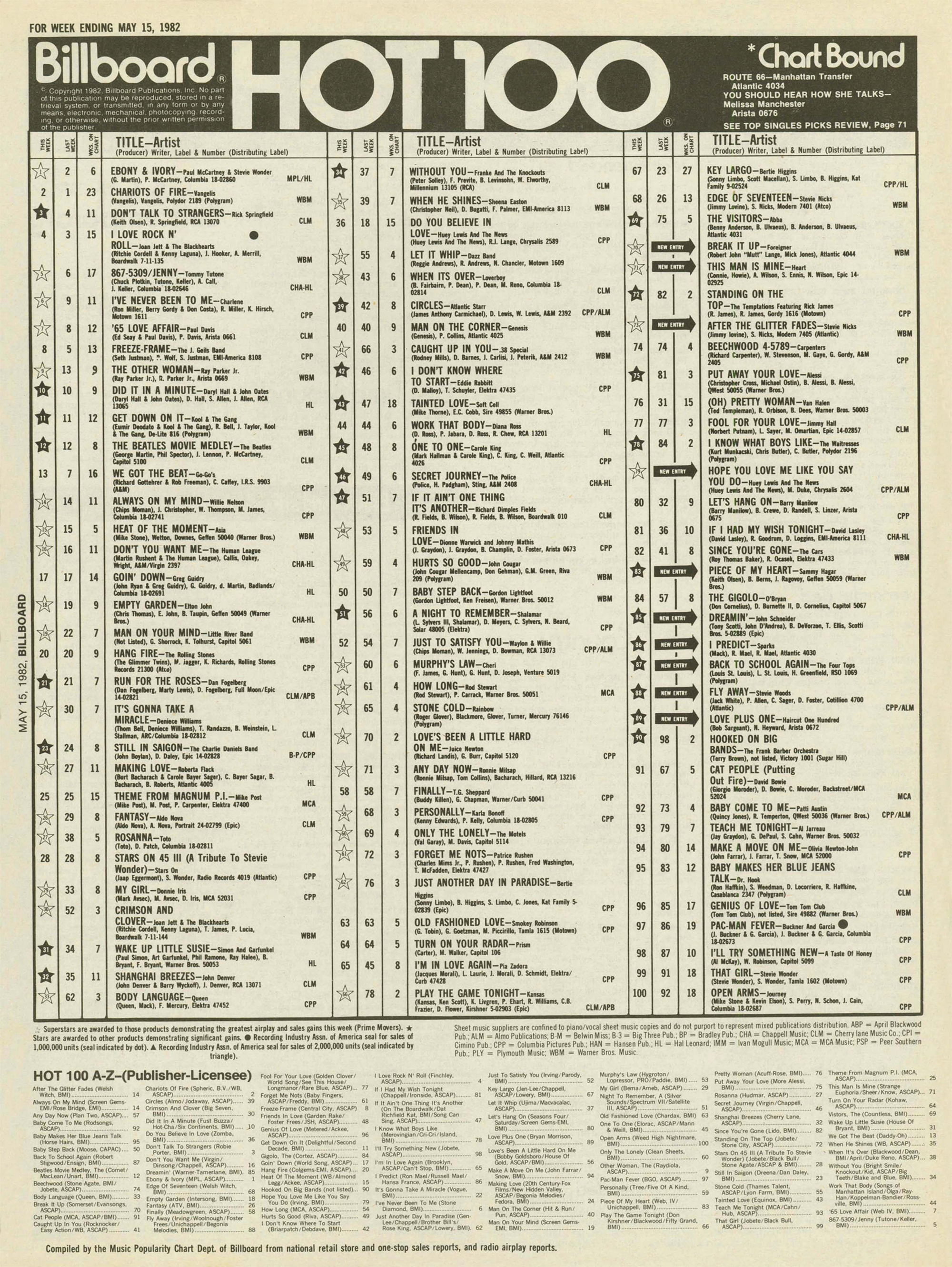
THIS WEEK IN AMERICA! BILLBOARD HOT 100: 05/15/82

BILLBOARD HOT 100 May 15, 1982


BILLBOARD HOT 100 TABULATED BY RECORDS RETAIL SALES AND RADIO AIRPLAY

BILLBOARD HOT 100 MAY 9-15, 1982


** A MCRFB VIEWING TIP **

ON YOUR PC?To fully appreciate this Billboard Hot 100 May 15, 1982 chart feature click on image 2x and open to second window. Click image anytime to return to NORMAL image size.

Click your server’s back button to return to MCRFB home page.

ON YOUR MOBILE DEVICE? Tap on chart image. Open to second window. “Stretch” chart across your device screen to magnify for largest print view.


Loading

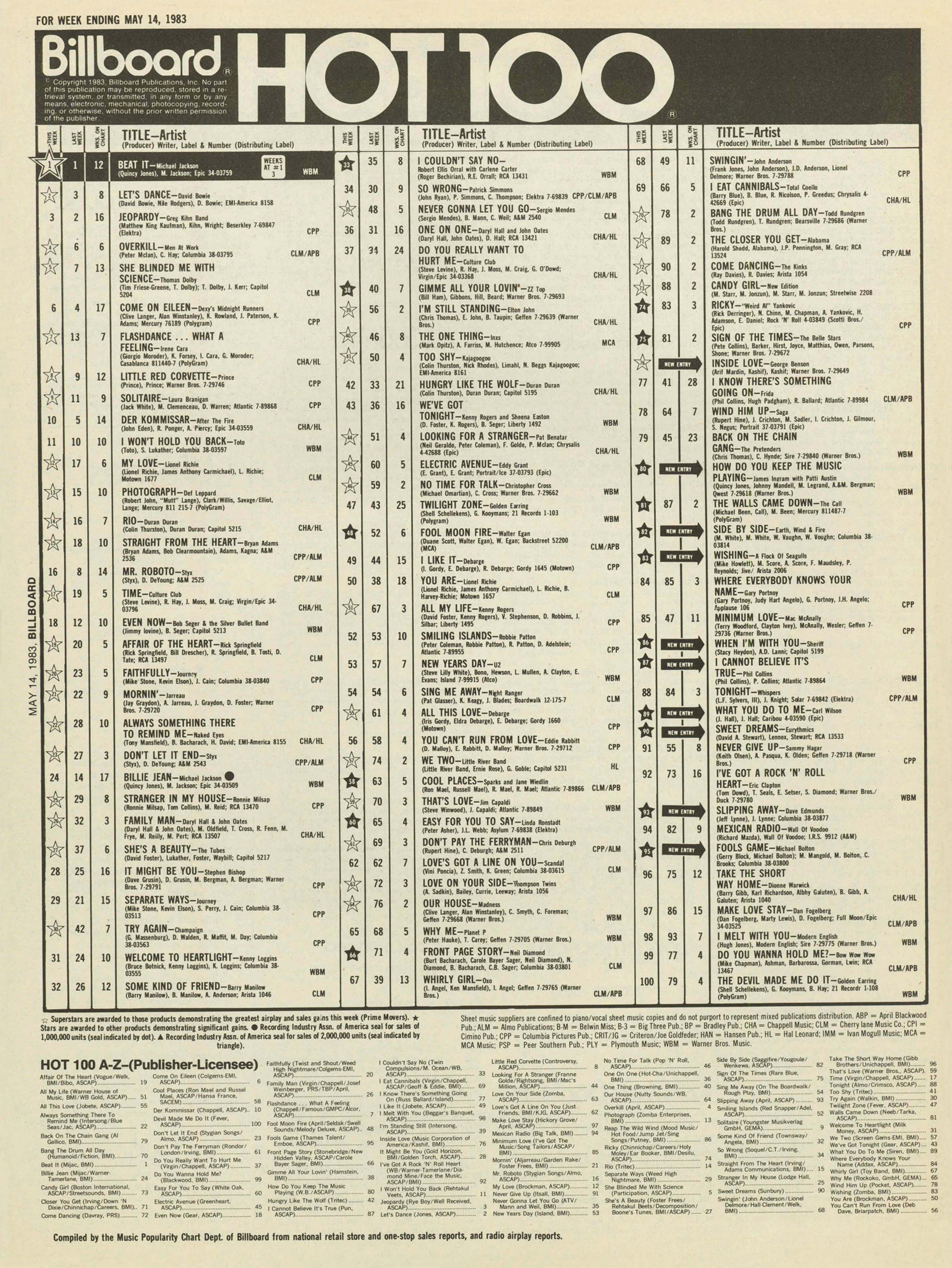
THIS WEEK IN AMERICA! BILLBOARD HOT 100: 05/14/83

BILLBOARD HOT 100 May 14, 1983


BILLBOARD HOT 100 TABULATED BY RECORDS RETAIL SALES AND RADIO AIRPLAY

BILLBOARD HOT 100 MAY 8-14, 1983


** A MCRFB VIEWING TIP **

ON YOUR PC?To fully appreciate this Billboard Hot 100 May 14, 1983 chart feature click on image 2x and open to second window. Click image anytime to return to NORMAL image size.

Click your server’s back button to return to MCRFB home page.

ON YOUR MOBILE DEVICE? Tap on chart image. Open to second window. “Stretch” chart across your device screen to magnify for largest print view.


Loading

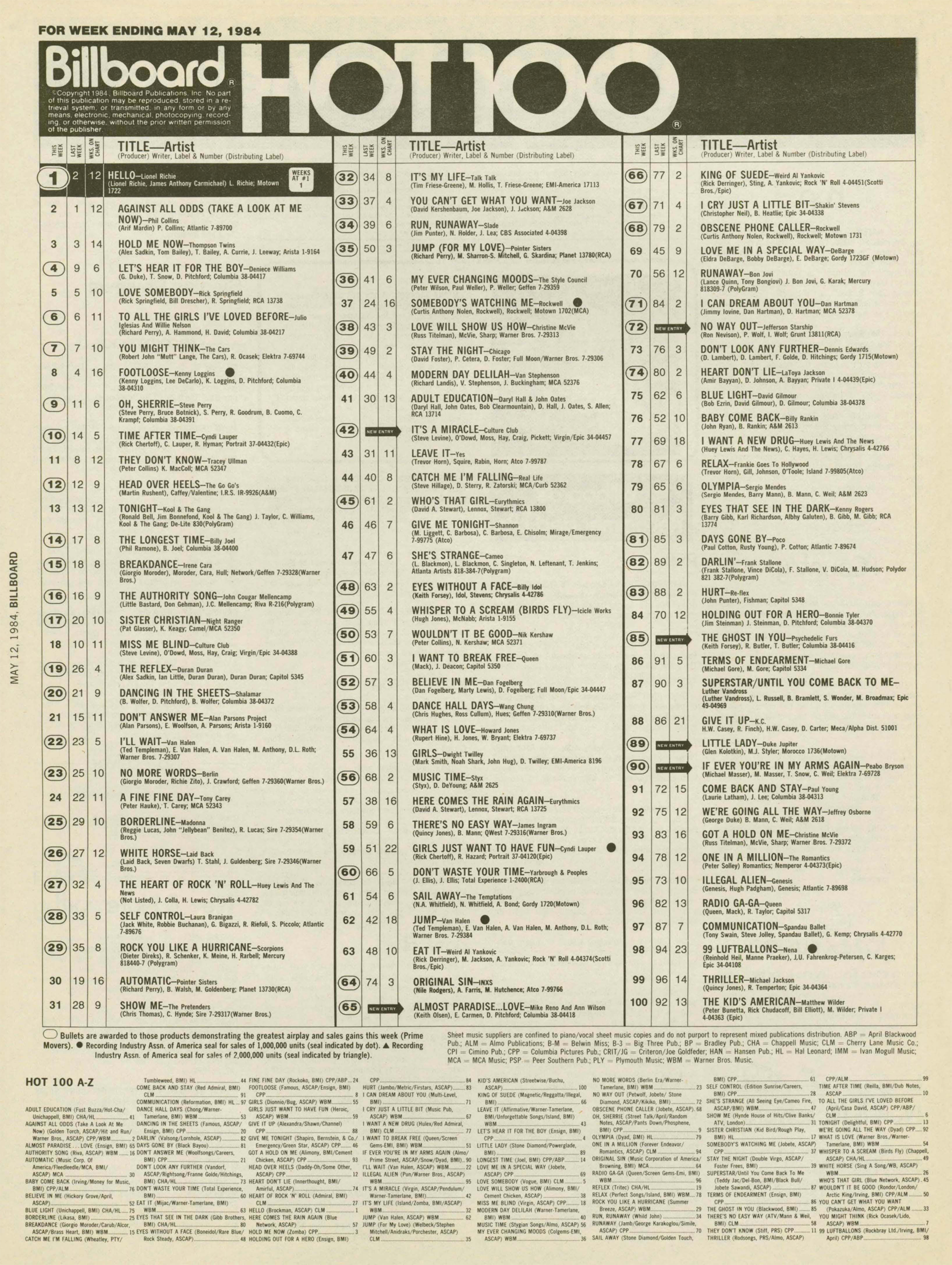
THIS WEEK IN AMERICA! BILLBOARD HOT 100: 05/12/84

BILLBOARD HOT 100 May 12, 1984


BILLBOARD HOT 100 TABULATED BY RECORDS RETAIL SALES AND RADIO AIRPLAY

BILLBOARD HOT 100 MAY 6-12, 1984


** A MCRFB VIEWING TIP **

ON YOUR PC?To fully appreciate this Billboard Hot 100 May 12, 1984 chart feature click on image 2x and open to second window. Click image anytime to return to NORMAL image size.

Click your server’s back button to return to MCRFB home page.

ON YOUR MOBILE DEVICE? Tap on chart image. Open to second window. “Stretch” chart across your device screen to magnify for largest print view.


Loading

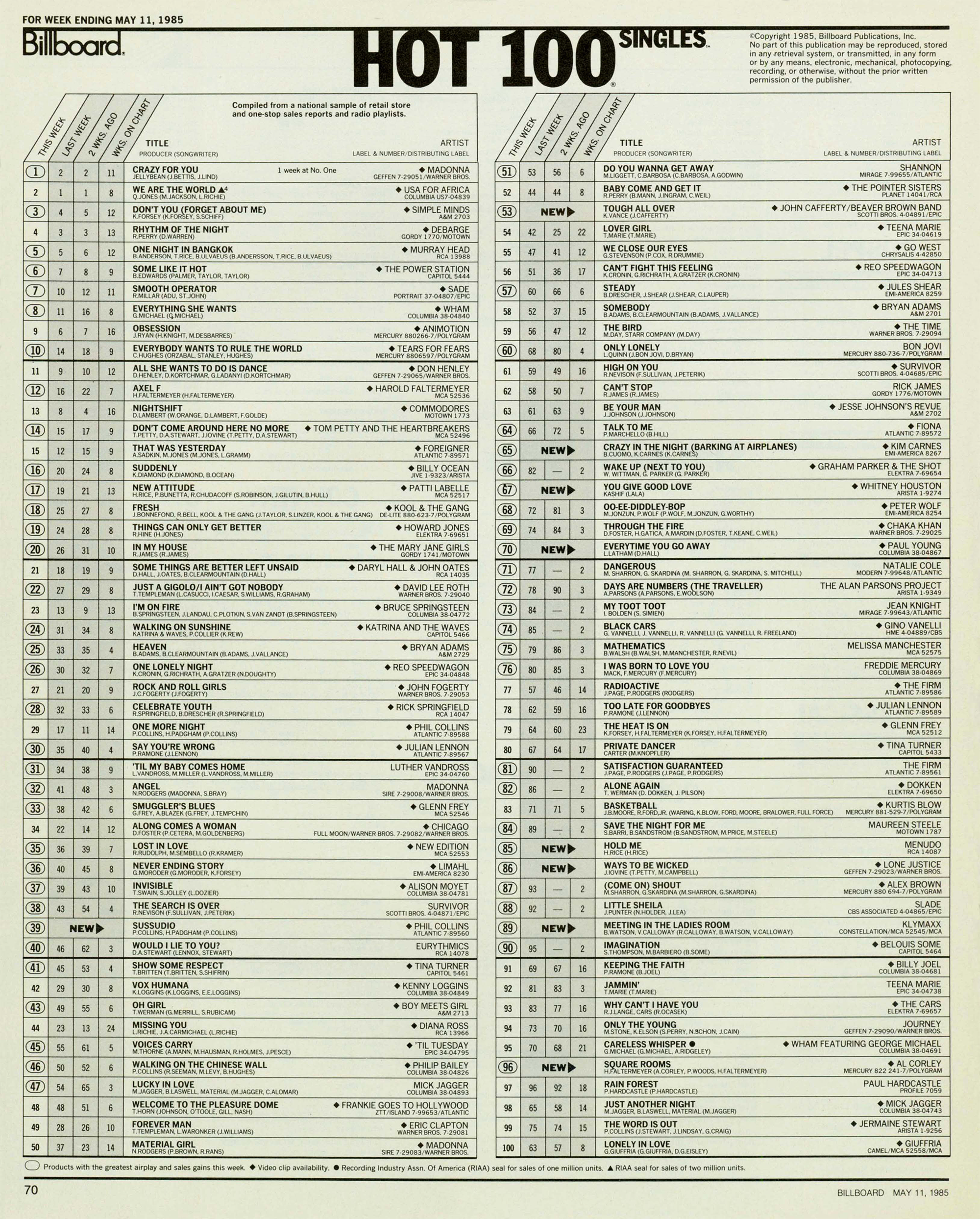
THIS WEEK IN AMERICA! BILLBOARD HOT 100: 05/11/85

BILLBOARD HOT 100 May 11, 1985


BILLBOARD HOT 100 TABULATED BY RECORDS RETAIL SALES AND RADIO AIRPLAY

BILLBOARD HOT 100 MAY 5-11, 1985


** A MCRFB VIEWING TIP **

ON YOUR PC?To fully appreciate this Billboard Hot 100 May 11, 1985 chart feature click on image 2x and open to second window. Click image anytime to return to NORMAL image size.

Click your server’s back button to return to MCRFB home page.


ON YOUR MOBILE DEVICE? Tap on chart image. Open to second window. “Stretch” chart across your device screen to magnify for largest print view.


Loading

DRAKE BLASTS RECORD MEN LABELING HIM TIGHT-PLAY ADDICT . . . AUGUST 12, 1967

From the MCRFB NEWS archive: 1967


NEW YORK — Bill Drake, programming consultant who has just been hired to guide all of the RKO General radio stations, lashed out at the record men who would tag him with the image of a tight playlist addict.

Drake, who scored ratings successes with both KFRC in San Francisco and KHJ in Los Angeles, was in New York last week trying to work his magic on an FM station – WOR-FM, a stereo operation that had already made a sizable dent in New York ratings with a rock ‘n’ roll format.

One of the first moves of Drake was to install Gary Mack, formerly of KHJ, as program director of the station, replacing Art Wander.

As for other changes in the station, Drake said he would try to improve the presentation of the music and the content. “The station will continue to play a lot of diverse album music, aiming at the 18 -35 age group. It’s going to be rock, using every type of LP cut. Oldies would have a lot of influence, a lot of Motown product, for example.”

He said that other stations under his banner had been playing album cuts, “but to take an album and put it in the control room and say the deejay can play from it is the same fallacy a lot of stations make in saying that Sinatra is a super star. You don’t play Sinatra for the sake of Sinatra; he’s had some bad cuts, too. You don’t play Dylan for the sake of Dylan, Sinatra for the sake of Sinatra, Motown for the sake of Motown.

“The object is to play the good Dylan, the good Sinatra,” he said. And a lot can determine this. People working at the various stations guided by Drake listen to every cut of every LP, every single. Drake credits his success to “hard work and the good people working with me.”

Swap Information

Information between the stations is exchanged in writing, there are conference telephone calls on the music itself, they all exchange playlists. “But the music lists at various stations vary an awful lot. This actually gives us the opportunity, contrary to opinion, to expose and test nine times as many records as anyone else. If a radio station plays three new different records each week that the other stations are not playing, this would run to 27 new records each week.”

Basically, he felt his radio station policy isn’t just to play the top few records. . . but he does advocate not playing “losing” records. “The object is to play winners. Its good for us, it’s good for the record companies. If you have a weak record on the air, it’s obviously going to limit the amount of exposure you can give a strong record.

“I could never understand why record companies wouldn’t be irritated because their good product was being hurt by the amount of weak product sometimes played.”

Fresh Product

Drake does believe definitely in playing new records, saying his stations were spinning LP cuts by the Jefferson Airplane before the group hit pay-dirt with the single. “You’ve always got to have fresh new product on the air, good new records. . . whether by a new or known artists. Otherwise your station winds up with a staleness.”

Playing records by and for the hippies will not lead to a successful radio station, he felt; he believes the whole of San Francisco movement is a myth. Request radio is also too narrowly aimed . . . “what’s wrong is that these stations get the teen-tween listeners. You want them, too, but not exclusively. Younger kids are the only ones, however, who have the time and patience to dial. They aren’t going anywhere anyway.”

The object of winning radio is to please everybody without going after them. “You play ‘Happy Together’ by the Turtles. ‘You Keep Me Hanging On’ by the Supremes. . . those are monster records that everybody likes.”

Still, aside from the “monster” policy, Drake’s stations do have some leeway. Tom Rounds, he said, picked up on “Ode To Billy Joe” early and began playing
it under the assumption it was going to become a monster.

The record hit the chart a week ago like gangbusters and it’s still climbing. So, obviously, is Drake. END


— Initially posted on Motor City Radio Flashbacks, August 10, 2016 —


___

Information and news source: Billboard; August 12, 1967


BILL DRAKE

Loading

SHANNON’S SPOT LIVE ON CKLW-TV . . . OCTOBER 5, 1968

From the MCRFB NEWS archive: 1968

Popular Big 8 Jock Finds Place On Local TV Dance Show


CKLW Tom Shannon 1967

CKLW Tom Shannon 1965

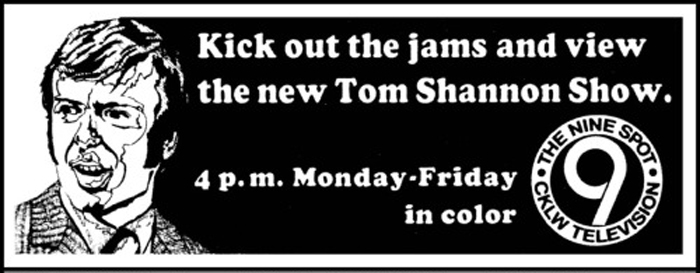
DETROIT — “The Lively Spot,” hosted by CKLW deejay Tom Shannon, bowed here on CKLW-TV (Channel 9) September 30 replacing the Robin Seymour “Swingin’ Time” show.

The show will be seen 3:30-4:30 p.m. Monday through Friday and 6-7 p.m. Saturday when it will be known as “The Tom Shannon Show.”

Shannon will continue his popular 6-9 p.m. CKLW-AM show on the radio. Elmer Jaspan, director of programming for CKLW-TV, predicts Shannon will became a great favorite of Detroit young people on local Detroit/Windsor (Canada) television.

Shannon joined CKLW four years ago. A songwriter, he wrote the 1963 hit, “Wild Weekend,” while a jock in Buffalo. He also wrote “Soul Clappin,” a local hit now currently playing Detroit radio. END


Initially posted on Motor City Radio Flashbacks, May 17, 2015

___

(Information and news source: Billboard; October 5, 1968)


Tom Shannon Show on CKLW TV-9; TV Guide ad March-22-28-1969


Loading

B. B. KING, WHO INSPIRED A GENERATION, DIES AT 89


OBITUARIES

BLUES LEGEND B. B. KING, INSPIRATION TO GENERATIONS OF MUSICIANS, DIES AT 89

 By Randy Lewis | LA TIMES Staff Writer | May 15, 2015, 12:04 AM


B. B. KING

B. B. KING

B.B. King, the singer and guitarist who put the blues in a three-piece suit and took the musical genre from the barrooms and back porches of the Mississippi Delta to Carnegie Hall and the world’s toniest concert stages with a signature style emulated by generations of blues and rock musicians, has died. He was 89..

The 15-time Grammy Award winner died Thursday night in his Las Vegas home, said Angela Moore, representative for his youngest daughter, Claudette. He had struggled in recent years with diabetes.

King died peacefully in his sleep, Claudette King told The Times.

Early on, King transcended his musical shortcomings — an inability to play guitar leads while he sang and a failure to master the use of a bottleneck or slide favored by many of his guitar-playing peers — and created a unique style that made him one of the most respected and influential blues musicians ever.

“B.B. King taps into something universal,” Eric Clapton told The Times in 2005. “He can’t be confined to any one genre. That’s why I’ve called him a ‘global musician.’”

Because King couldn’t figure out how to play and sing simultaneously, he separated the two functions, laying the blueprint for the sung verse followed by the extended solo passage that would become a crucial element in blues as well as in rock music rooted in the blues. That template was exploited by subsequent generations of players, from Clapton and Jimi Hendrix on through to John Mayer and the Red Hot Chili Peppers.

Finding that he couldn’t make his elegantly long but thick fingers work the beer bottlenecks and metal slides used by so many other blues guitarists, he discovered that he could emulate that effect by rocking the fingers of his left hand rapidly on the guitar’s frets similar to the way a classical violinist creates vibrato, establishing a ringing tremolo that became his hallmark.


MCRFB Note: For the rest of this Los Angeles Times B. B. King Obituary article (May 15, 2015) please GO HERE.

___

Randy Lewis | Copyright © 2015 Los Angeles Times


Initially posted on Motor City Radio Flashbacks, May 17, 2015


September 25, 1925 – May 15, 2015

Loading